Lake Rotorua, situated in the Bay of Plenty region is a ~79.9km2 (by surface area) volcanic crater lake with a maximum depth of 45 meters.
Although coined the largest lake in its region, its mean depth of just 10meters results in a shallow lake classification. Shallow lakes are particularly susceptible to climate driven shifts across short and long term scales. Shallow lakes heat up faster than deep lakes which results in larger seasonal and diurnal temperature fluctuations (Frassl et al. 2018). Shallow lakes also tend to be more susceptible to atmospheric forcing, where wind, air temperature and precipitation patterms which influence water quality and consequent biology. Lake Rotorua experiences cyanobacteria blooms, partially due to its location in the landscape (hydrothermal + agriculture + population density), which receive high nutrient content along with warmer temperatures. In addition to temperature fluxes influencing cyanobacterial fluxes, wind and rain play a role in the intensity and location of these blooms. Wind drives cyanobacterial location, often leading to cyanobloom intensification/concentration in particular areas.
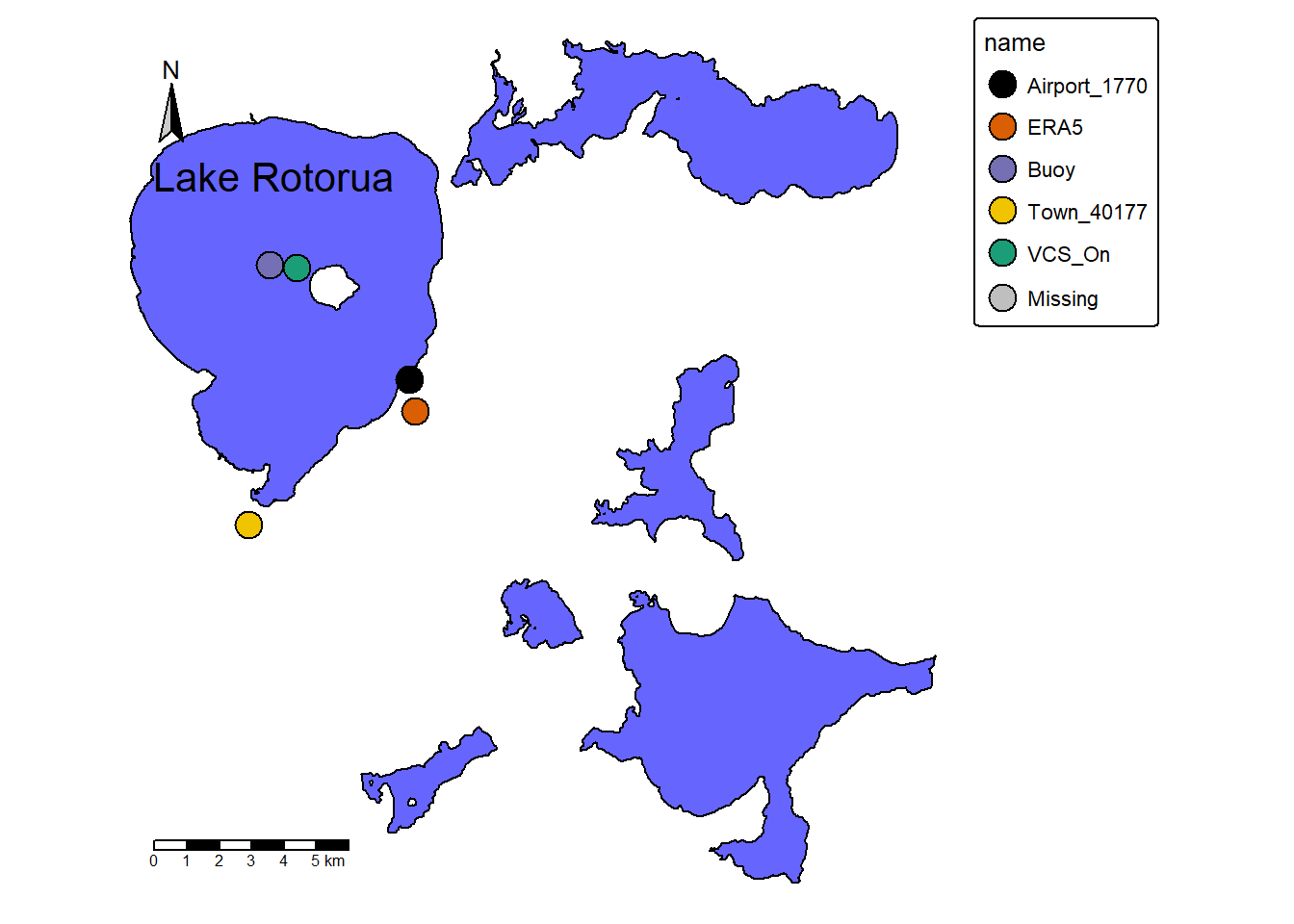
For Lake Rotorua the sites and locations selected were; Limnotrack Buoy (lat:-380550S Lon:1761653E) on lake, NIWA virtual climate station network (VCSN) grid NO:27879 lat:-38.075 lon:176.275, ERA5 statlite data for Lat:-38.114908 and Lon:176.316662, Observational data “Airport” station 1770 (lat:-38.10592 lon:176.31481), Observational data “Town” station 41077 (lat:-38.14635 lon:176.2578).
Study area
Code
# Note: Chage Quarto title Lat and lon to render your location of choicelibrary(leaflet)# Interactive overview map centred on the lakeleaflet() |>addTiles() |>addCircles(lng = params$lon,lat = params$lat,radius = params$buffer_km *1000,color ="dodgerblue",fillOpacity =0.25,popup = params$lake_name ) |>addCircleMarkers(lng = params$lon,lat = params$lat,radius =6,color ="navy",fillOpacity =0.9,popup = params$lake_name ) |>setView(lng = params$lon, lat = params$lat, zoom =11)
Map of Rotorua lakes showing data source locations
Code
library(osmdata)library(sf)library(tmap)library(rnaturalearth)library(rnaturalearthdata)library(dplyr)library(tibble) # for tribble()# Download nearby water polygons to outline the lakeoptions(timeout =10)bb <-c( params$lon -0.1, params$lat -0.1, params$lon +0.1, params$lat +0.1)osm_lake <-tryCatch(opq(bbox = bb) |>add_osm_feature(key ="natural", value ="water") |>osmdata_sf(),error =function(e) NULL)lake_poly <-NULLif (!is.null(osm_lake) &&!is.null(osm_lake$osm_multipolygons) &&nrow(osm_lake$osm_multipolygons) >0) { lake_poly <-st_make_valid(osm_lake$osm_multipolygons)}# Fallback: if no polygon returned (or OSM query failed), use the bounding boxif (is.null(lake_poly) ||nrow(lake_poly) ==0) { lake_poly <-st_polygon(list(rbind(c(bb[1], bb[2]),c(bb[3], bb[2]),c(bb[3], bb[4]),c(bb[1], bb[4]),c(bb[1], bb[2]) ))) |>st_sfc(crs =4326) |>st_as_sf()}# Change lon and lat to render your location of choice #change names to match locations# Station metadata (decimal degrees)stations <-tribble(~name, ~lon, ~lat, "Airport_1770", 176.31481, -38.10592, "ERA5", 176.316662,-38.114908, "Buoy", 176.2653, -38.0740, "Town_40177", 176.2578, -38.14635, "VCS_On", 176.275, -38.075)stations <- stations |>mutate(name =trimws(name))#Change names to match your Data set where nessesarystation_palette <-c(Airport_1770 ="black",ERA5 ="#d95f02",Buoy ="#7570b3",Town_40177 ="#f0c400",VCS_On ="#1b9e77")stations <- stations |>filter(!is.na(name), name %in%names(station_palette)) |>mutate(name =factor(name, levels =names(station_palette)))stations_sf <-st_as_sf(stations, coords =c("lon", "lat"), crs =4326)# Use combined extent of lake + stations, with a small buffer (degrees)map_extent <-st_union(lake_poly, st_geometry(stations_sf)) |>st_bbox() |>st_as_sfc() |>st_buffer(dist =0.005) # shrink/expand to tastetmap_mode("plot")tm_shape(lake_poly, bbox =st_bbox(map_extent)) +tm_fill(col ="blue", alpha =0.6) +tm_borders(col ="black") +tm_shape(stations_sf) +tm_symbols(col ="name",palette = station_palette,shape =21,size =1,border.col ="black" ) +tm_compass(type ="arrow",position =c("left", "top"),color.dark ="black",color.light ="gray80" ) +tm_scale_bar(position =c("left", "bottom")) +tm_layout(title = params$lake_name,frame =FALSE,legend.outside =TRUE,legend.title.size =0.8,legend.text.size =0.7,legend.format =list(digits =2) )
Please refer to the methods tab for further detail.
Lake Rotorua analysis
For Rotorua there seems to be no single “best” dataset, rather, there are better choices to make depending on what variable you wish to use and for what purpose. All quantitative performance statements below are relative to the Airport_1770 reference and overlap period (Table: Metrics; Table: Coverages).
NoteClick to see data coverage table
NoteClick to see metrics table
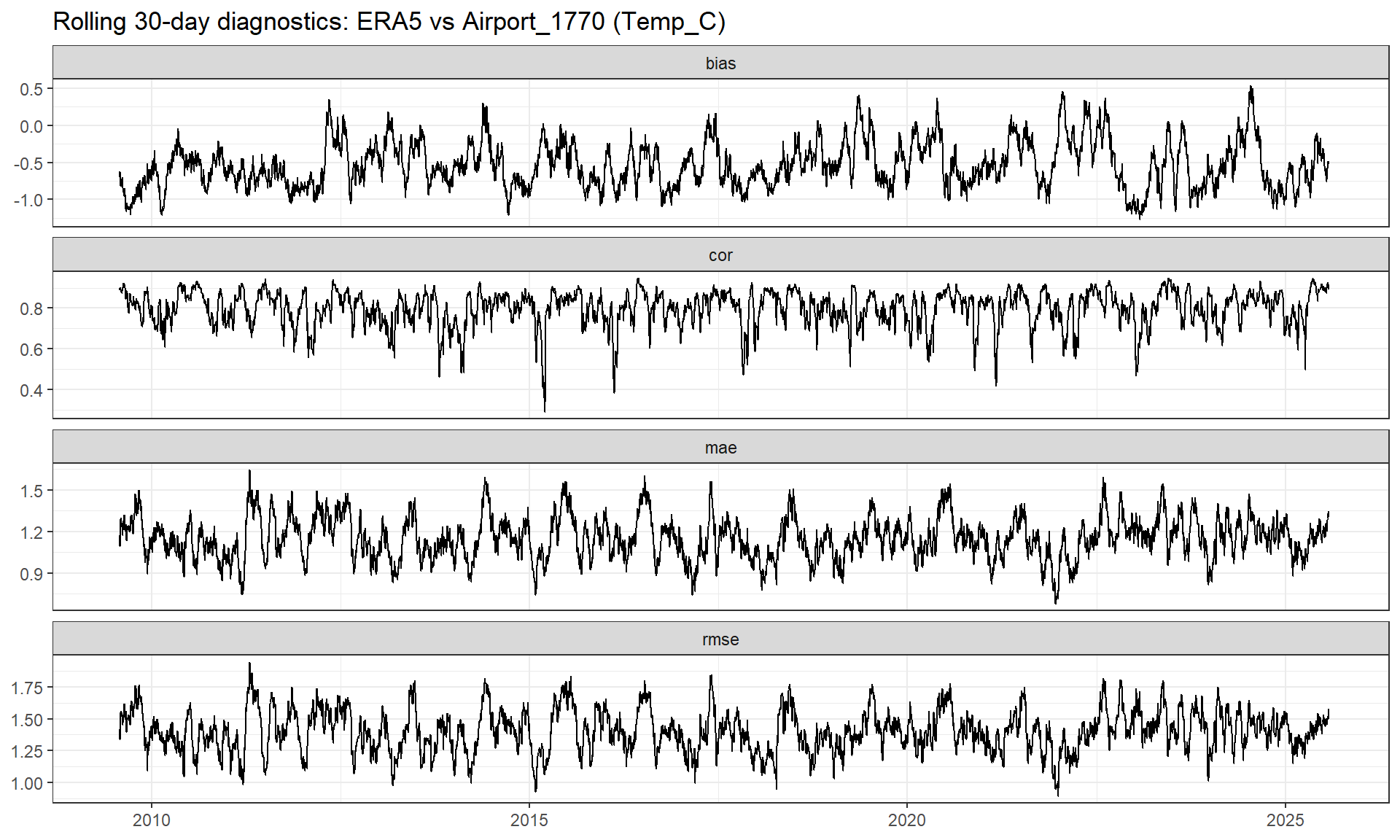
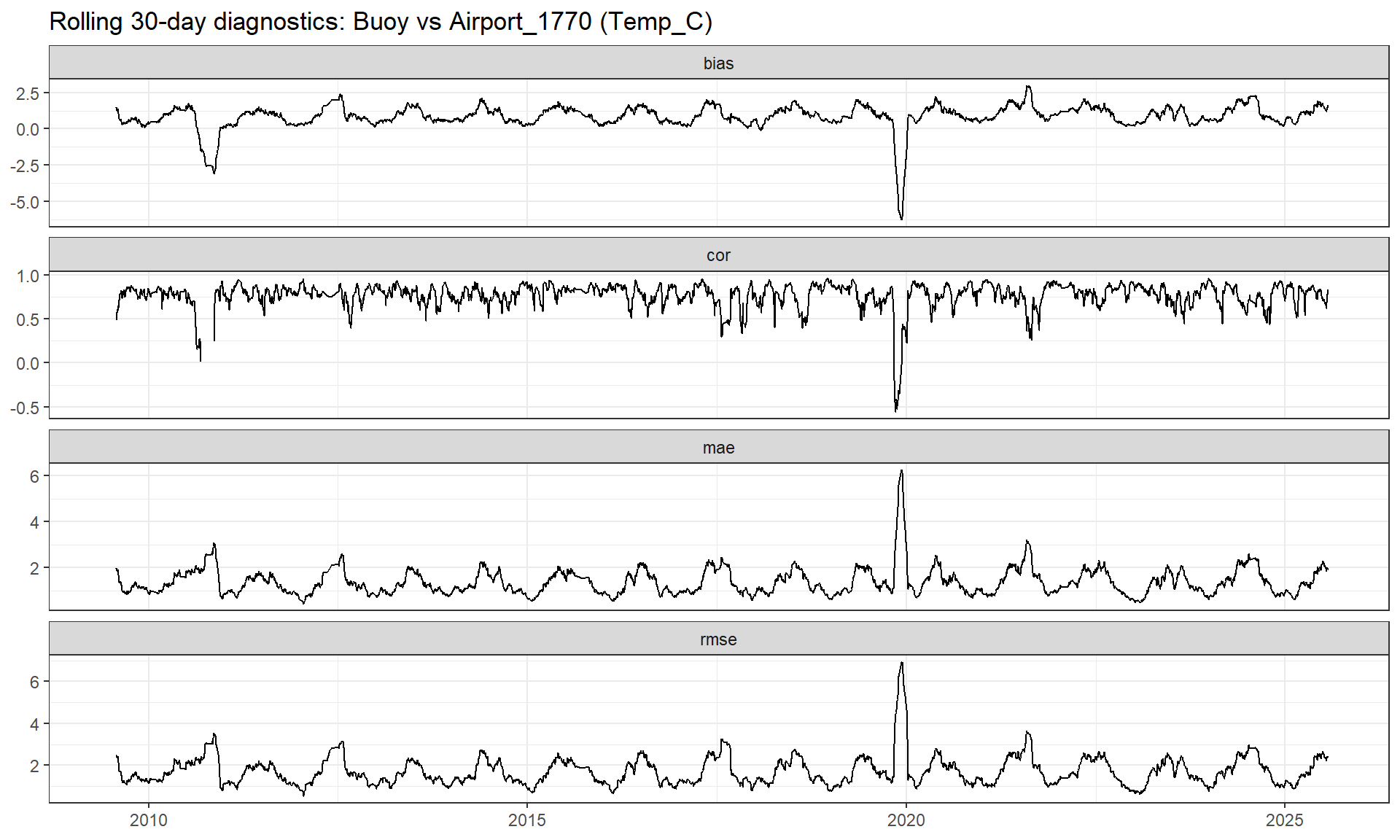
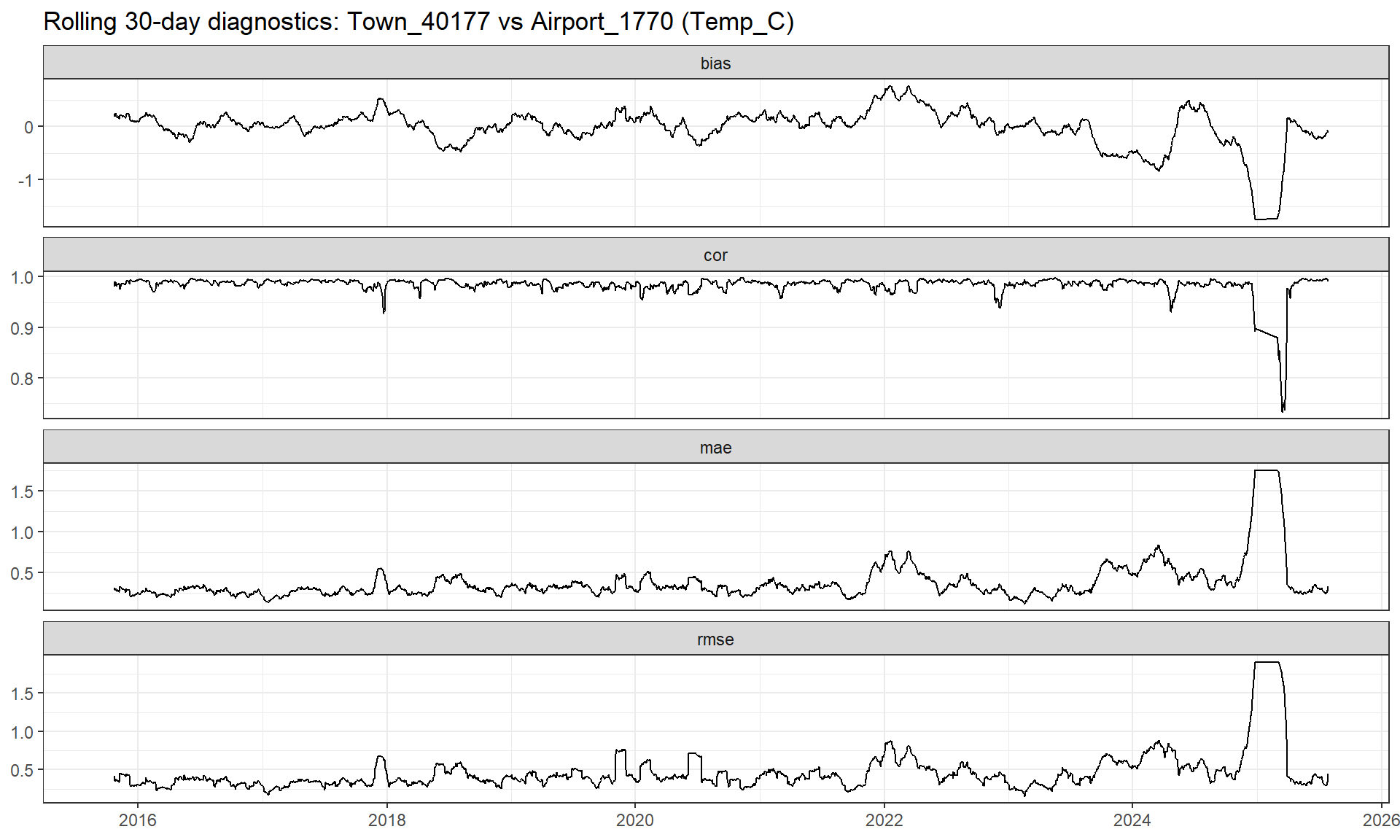
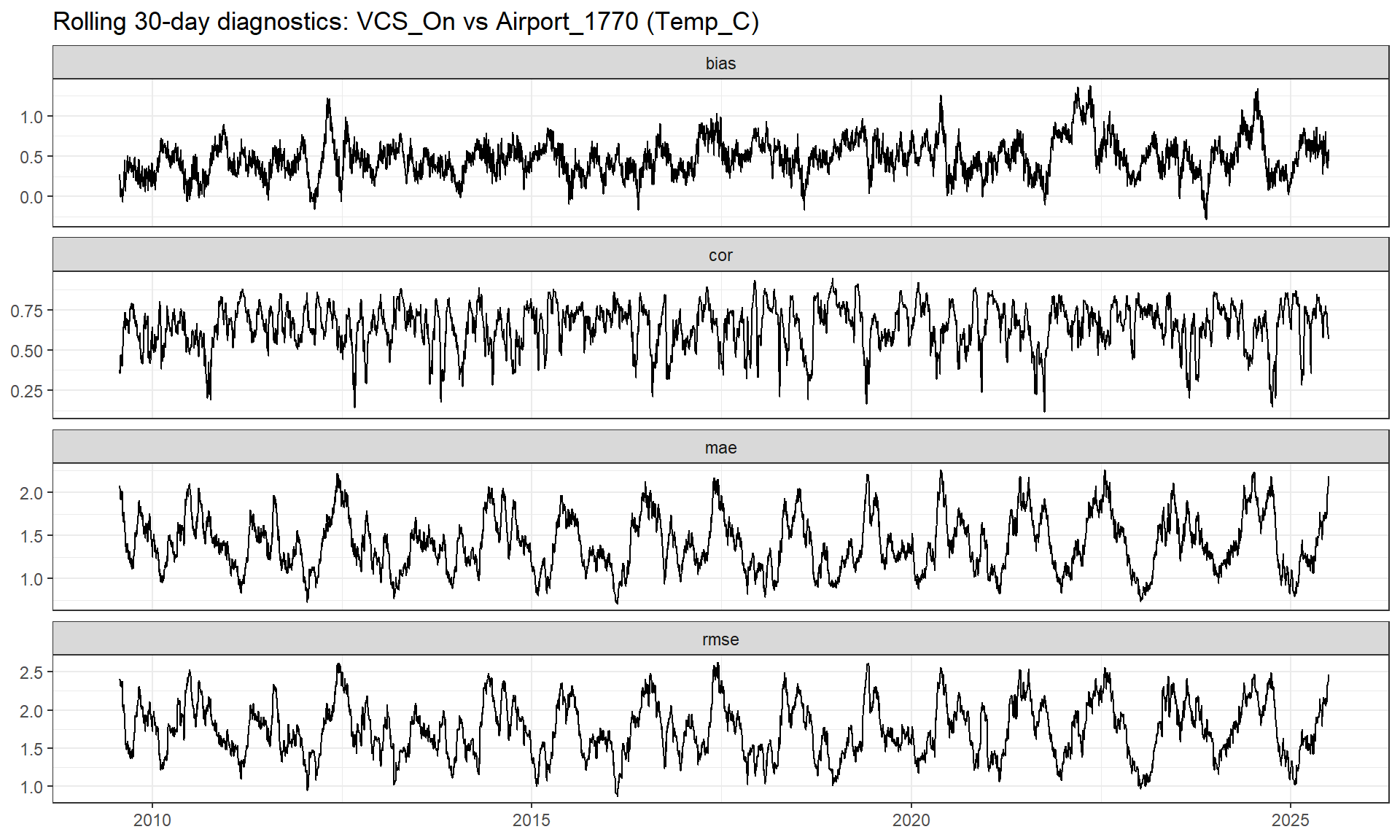
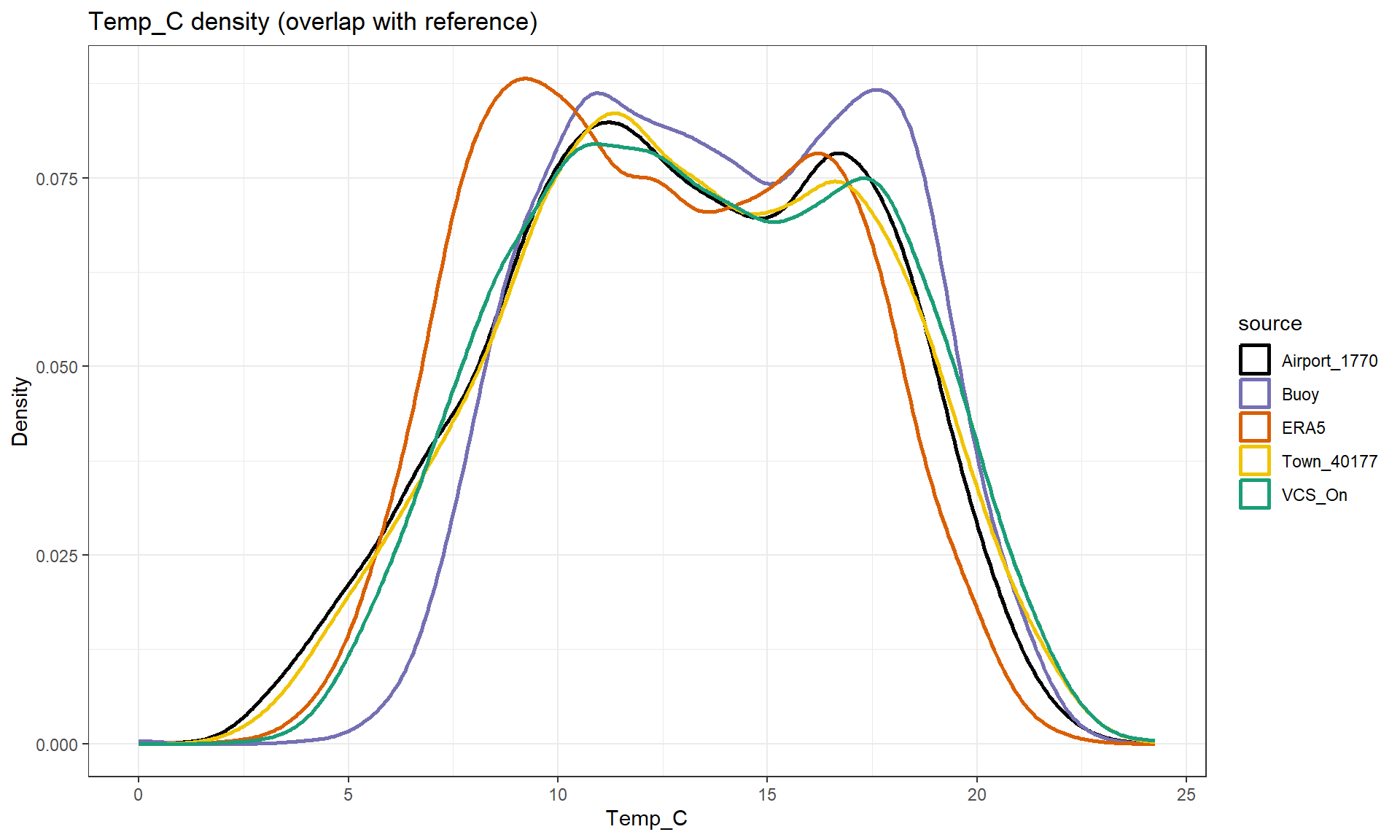
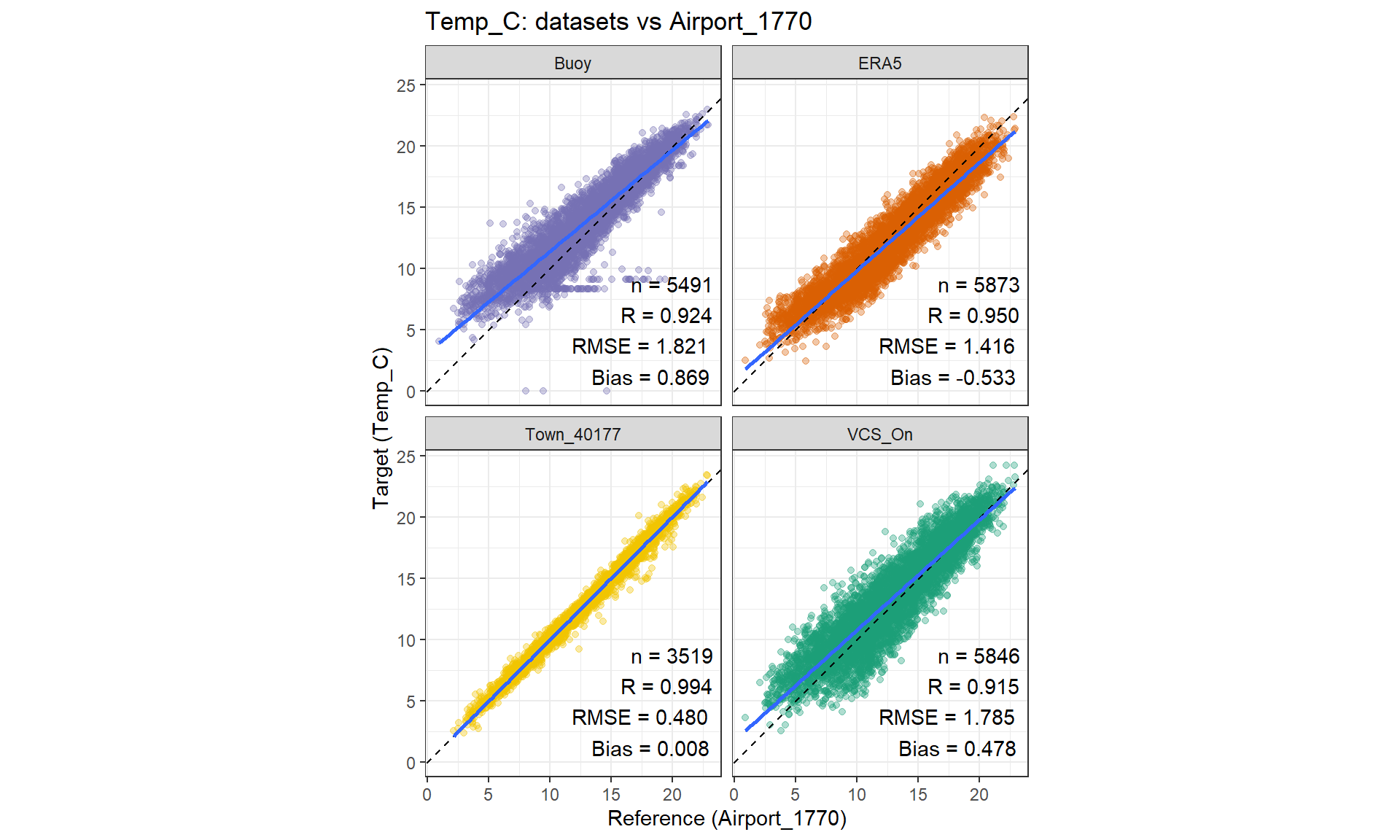
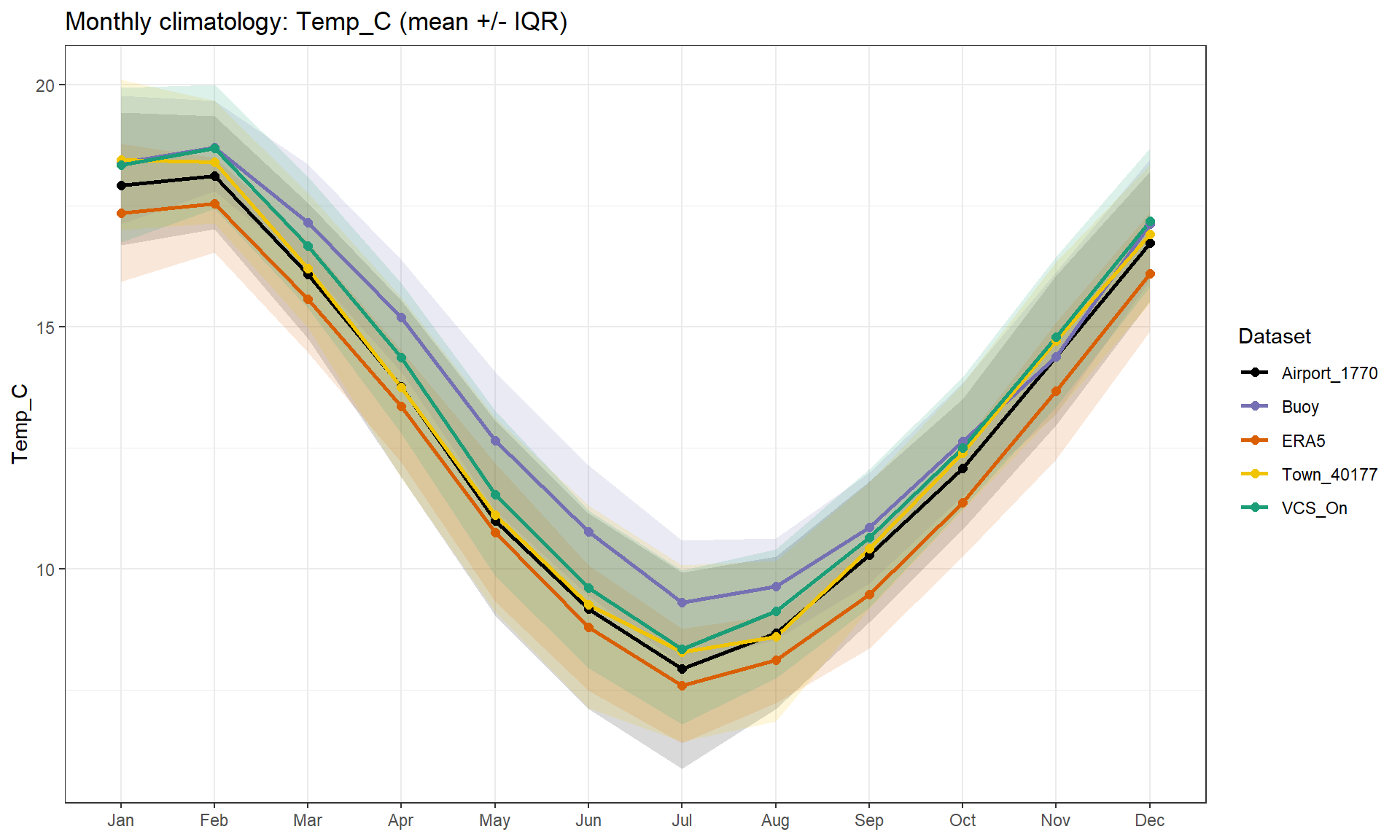
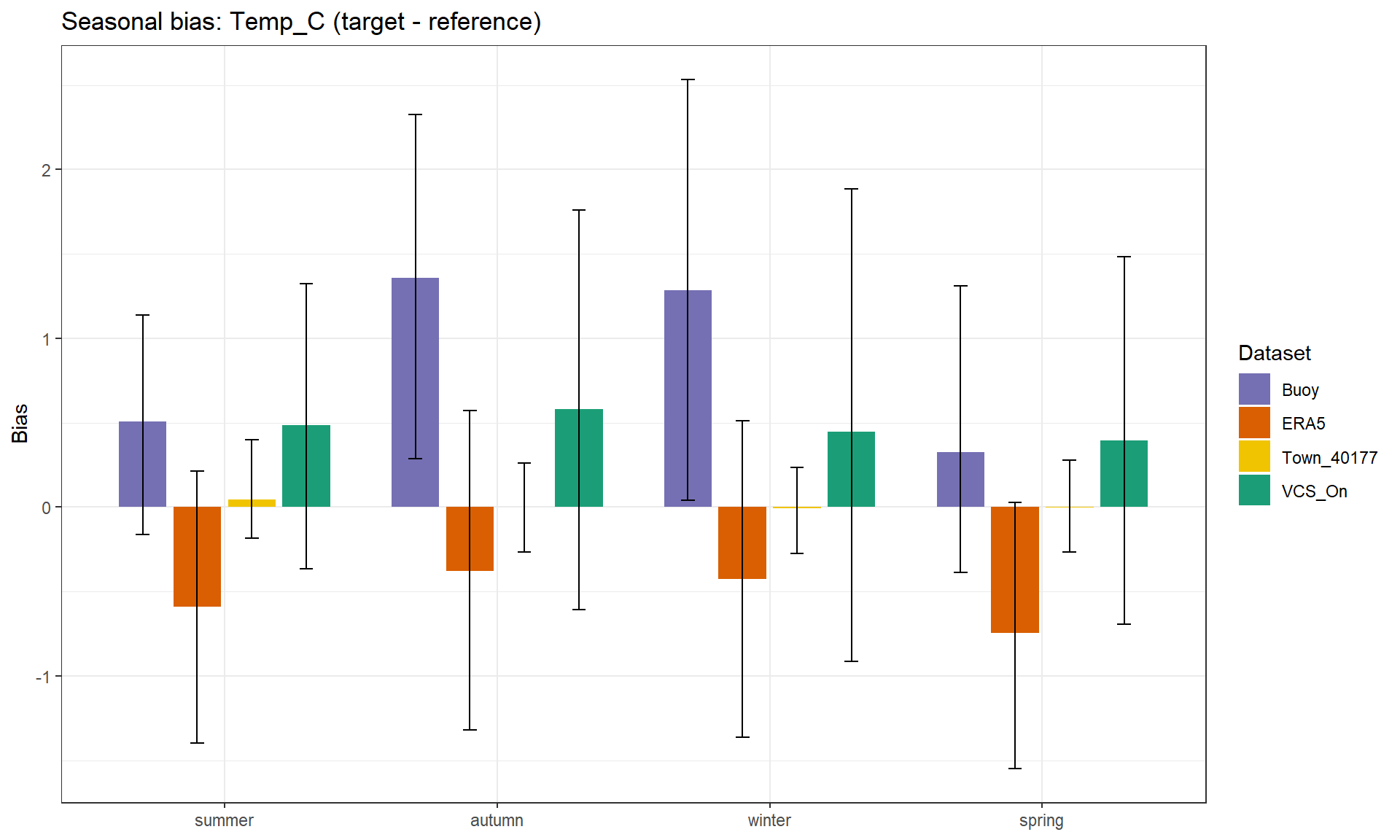
The general strong correlation for ERA5 temperature indicates good temporal tracking most of the time (Figure: Rolling 30-day temperature diagnostics). with consistent performance rather than episodic failures shown in steady MAE/RMSE. Although ERA5 looks suitable in the case of temperature variability, it should be bias corrected for absolute values with the understanding it shows a cool overall bias (Figure: Temperature Scatter) (Figure: Climatology temperature). Buoy temperatures tend to exceed airport temperatures with an overall warm bias. Two distinct short periods show large negative bias and severe error spikes, consistent with data issues or equipment errors. In fact, the historical data for this project was not quality assured and does have errors. For example, a times temperature sits at 10.5 degrees for a week. Additionally in late 2019 equipment errors occur showing a consistent 90 degrees for around two months. This temporally long 90 degree reading was redacted for better comparison in this project. This shows the unstable nature of the historical data used, which is evident in the time series data where at times the variables were not consistently recorded accurately. Outside these events, correlation is high, and errors are low, suggesting strong agreement. Overall, the Buoy temperature is reliable for most of the record, but errors should be excluded or corrected. Town station closely matches the airport on average with a near-zero bias for most of the year. Sharp shifts near the end of the series, with increase in error and reduced correlation mirroring the shifts indicate recording errors. Temporal coherence is high except during the 2025 anomaly showing high correlation. Although the Town_40177 temperature is generally consistent with the airport, recent data should be checked for change or quality issues before use suggesting stable but less tightly aligned agreement than station station comparisons. VCS_On temperatures have a consistent warm bias compared to the airport values across the record. The lack of outliers shows more a more stable nature. VCS_On can represent temperature trends rather accurately. Advise would be to bias correct and have caution around the daily scale accuracy. It is key to note the VCSN it the closest data point to the Buoy, so temperature fluctuations may be more representative of a water based temperature dynamics due to thermal buffering rather than land based. For limnological applications this is key to consider due to potentially better and more accurate on lake representation.
NoteRolling diagnostics plots (Temp)
(a) ERA5 vs Airport
(b) Buoy vs Airport
(c) Town vs Airport
(d) VSCN vs Airport
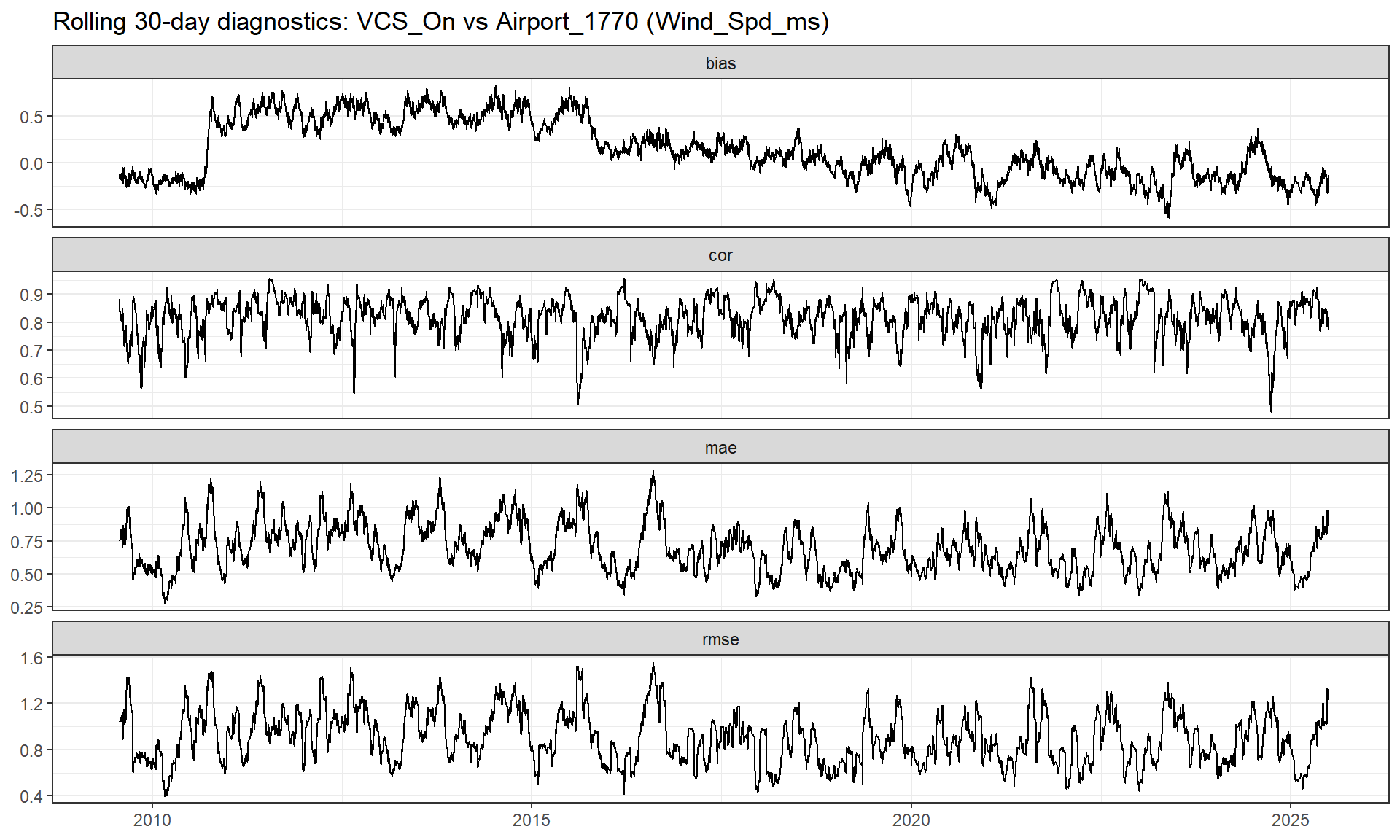
Figure 1: Rolling 30‑day diagnostics for daily temp (°C) comparing data target sources (Town_40177, ERA5, VSCN and Buoy data) to the reference (Airport_1770). Panels show 30‑day moving bias (source/target − reference), Pearson correlation (cor), mean absolute error (MAE), and Root mean square error (RMSE).
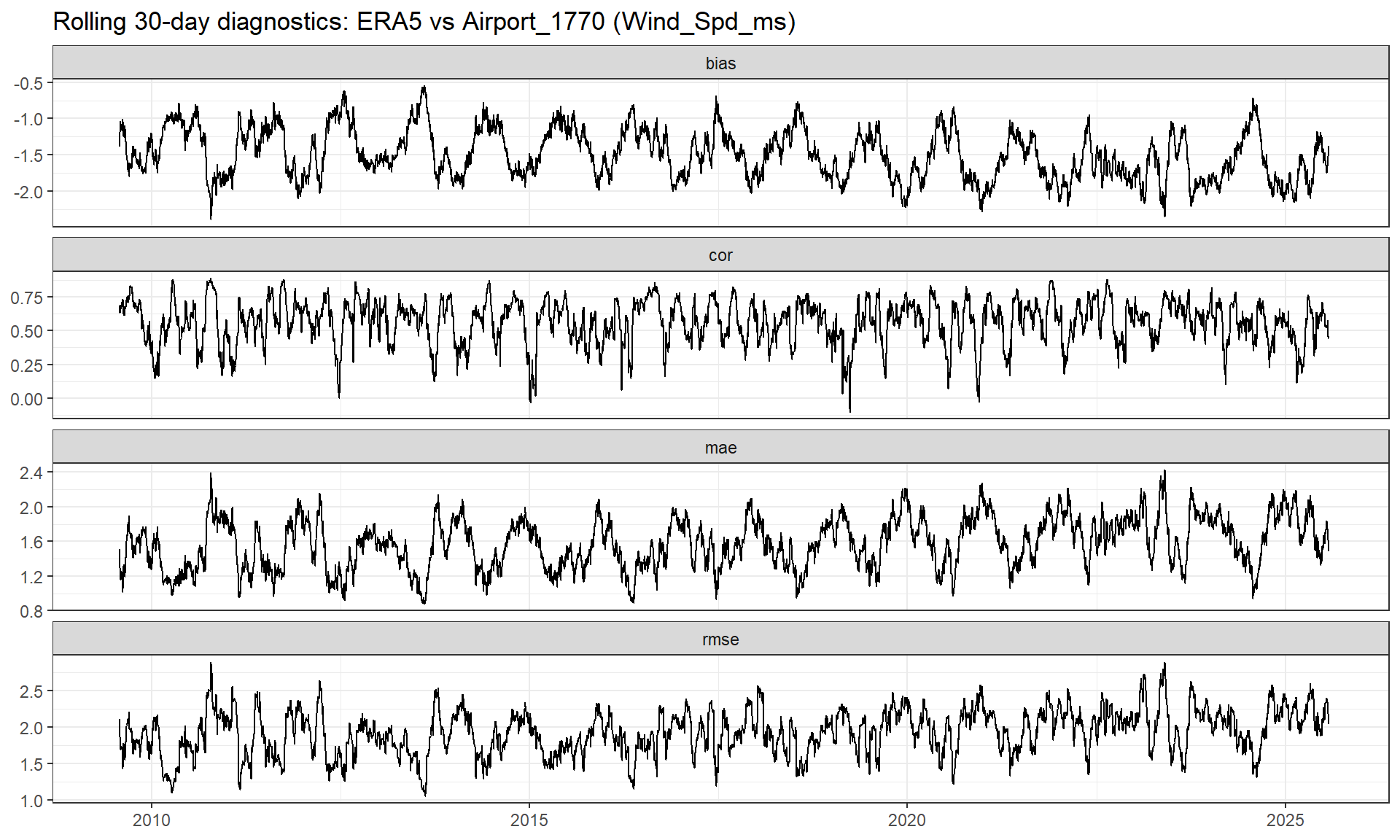
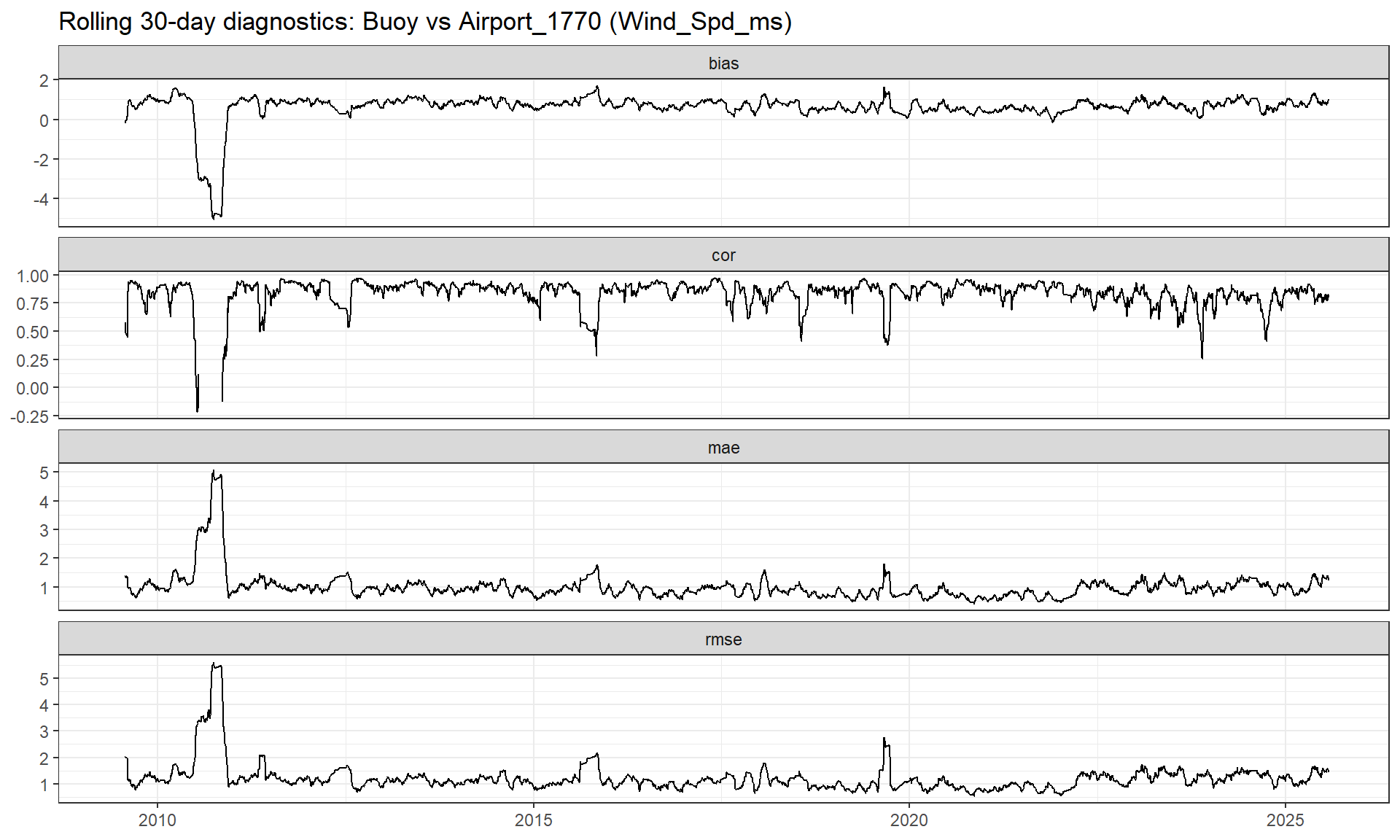
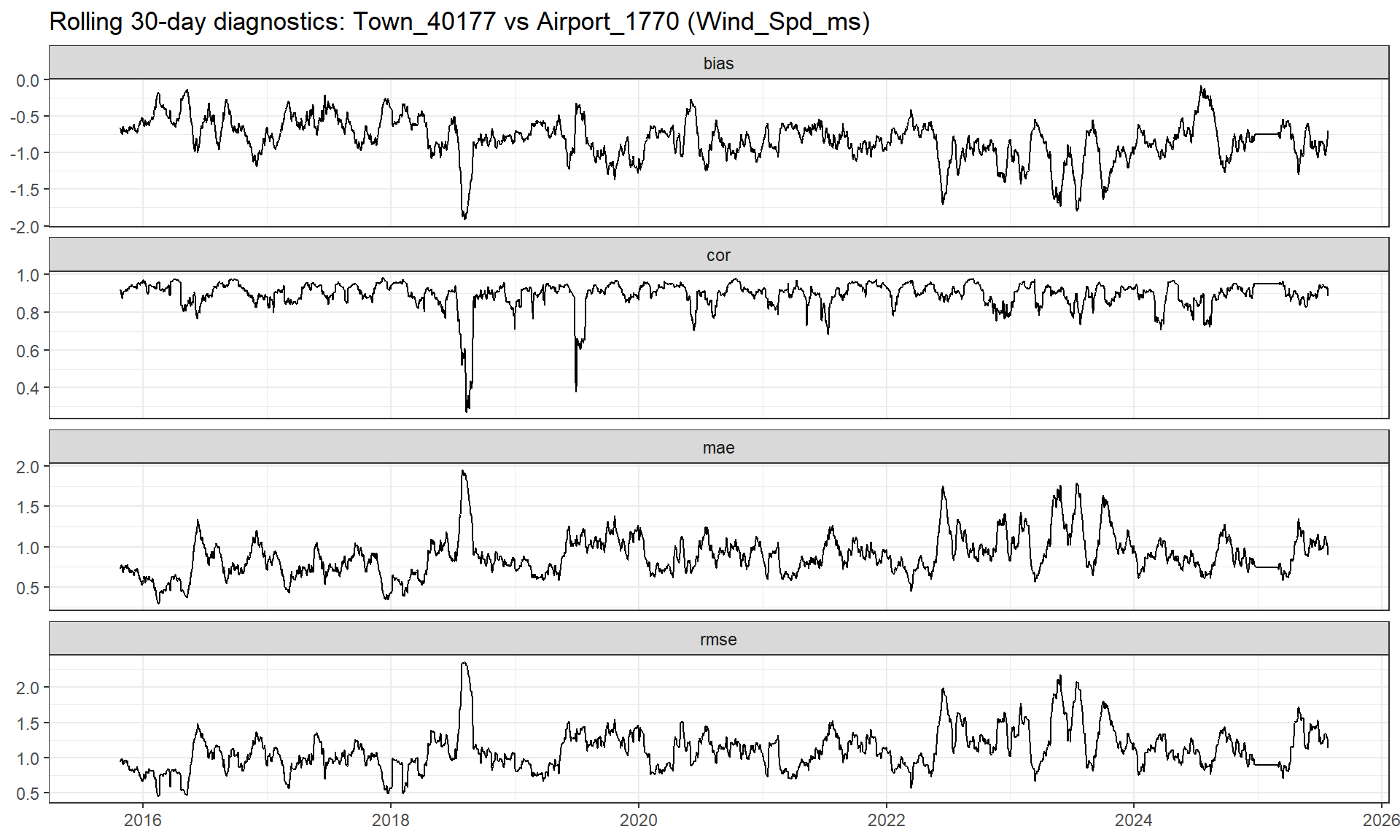
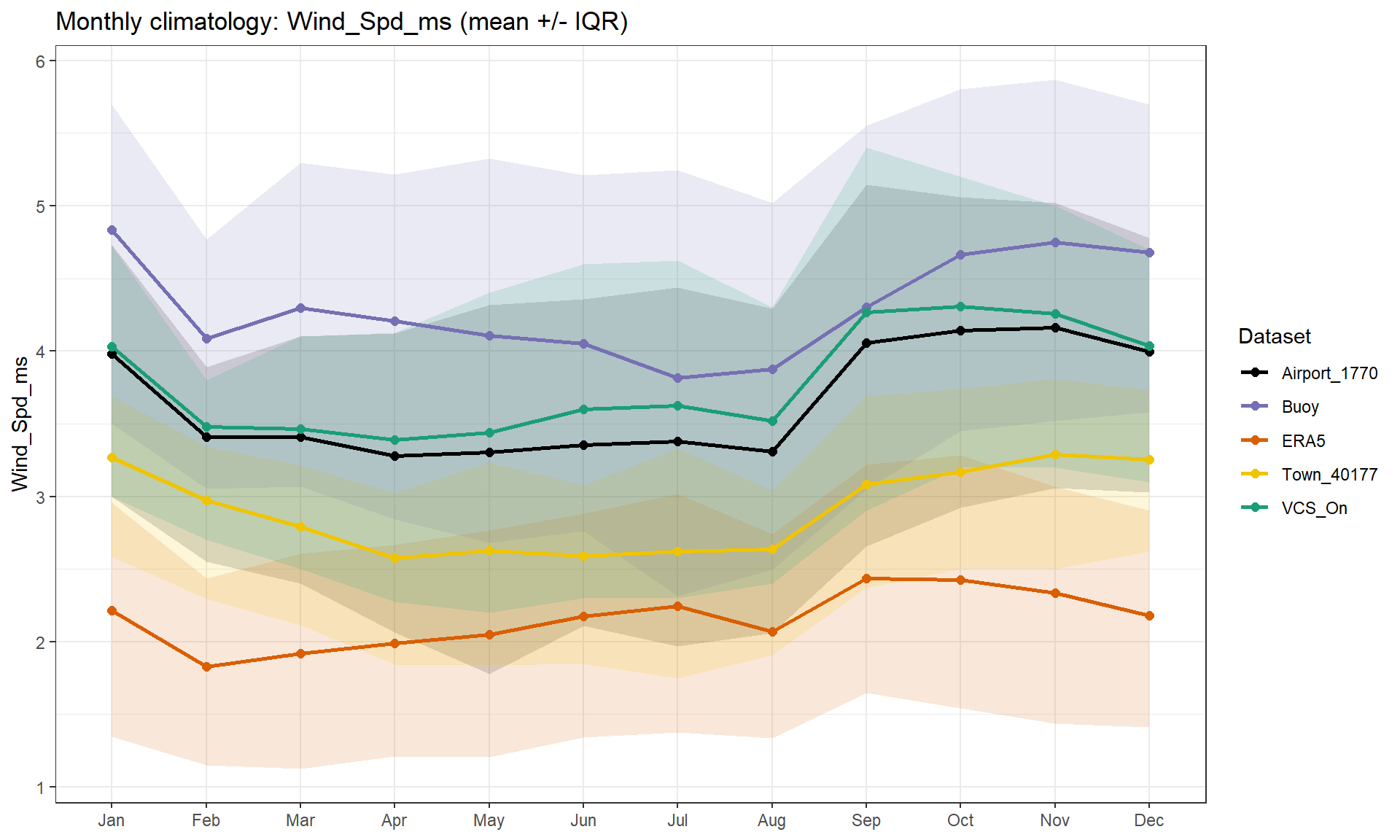
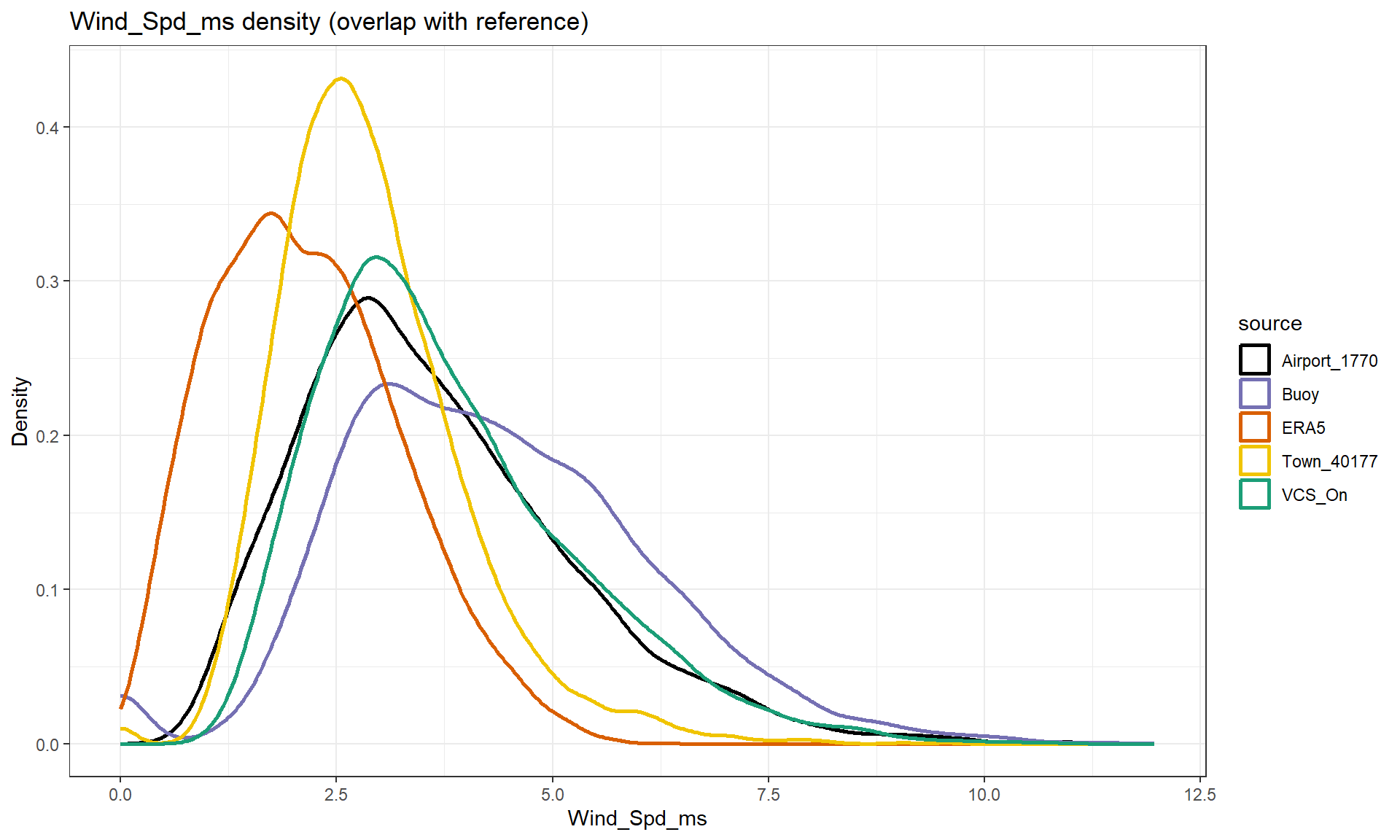
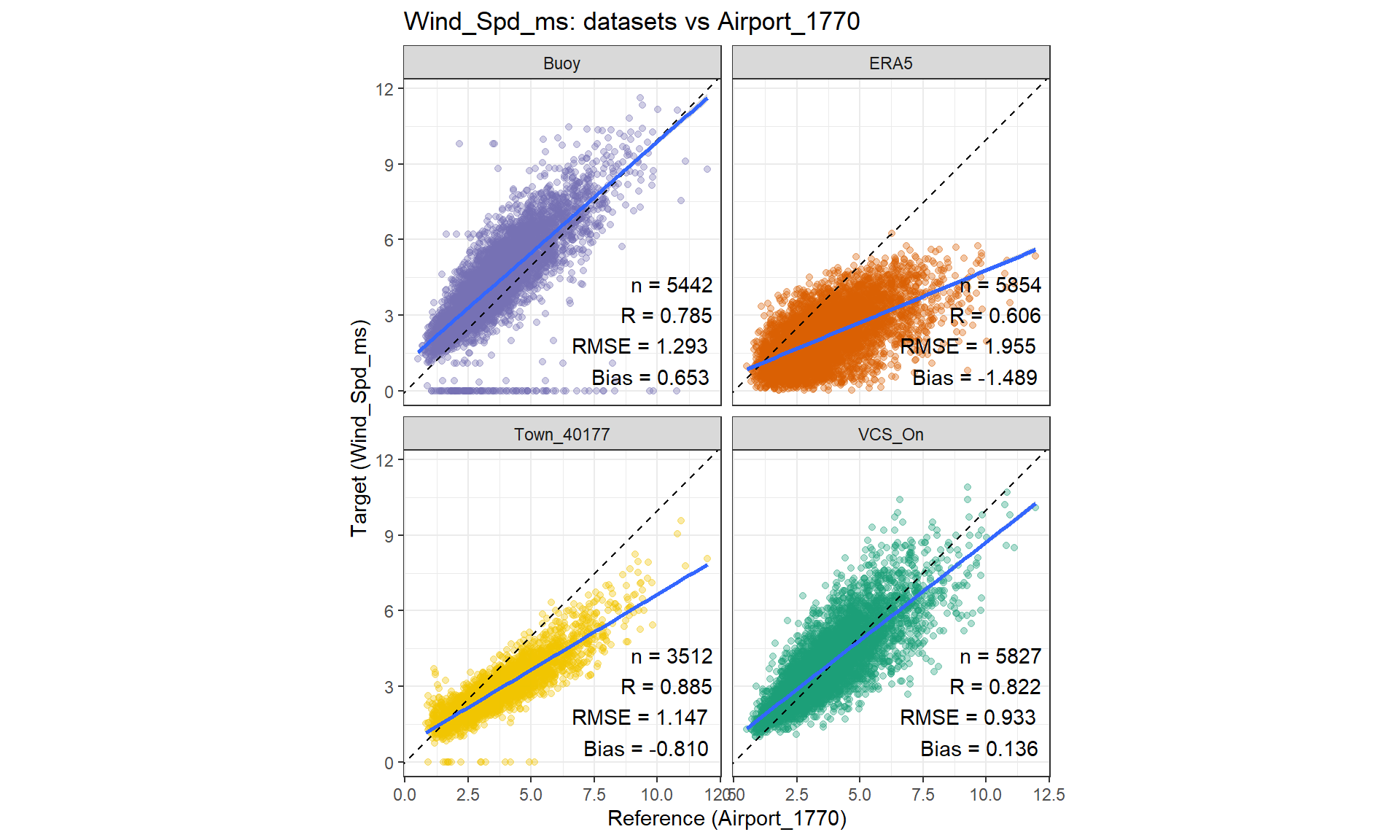
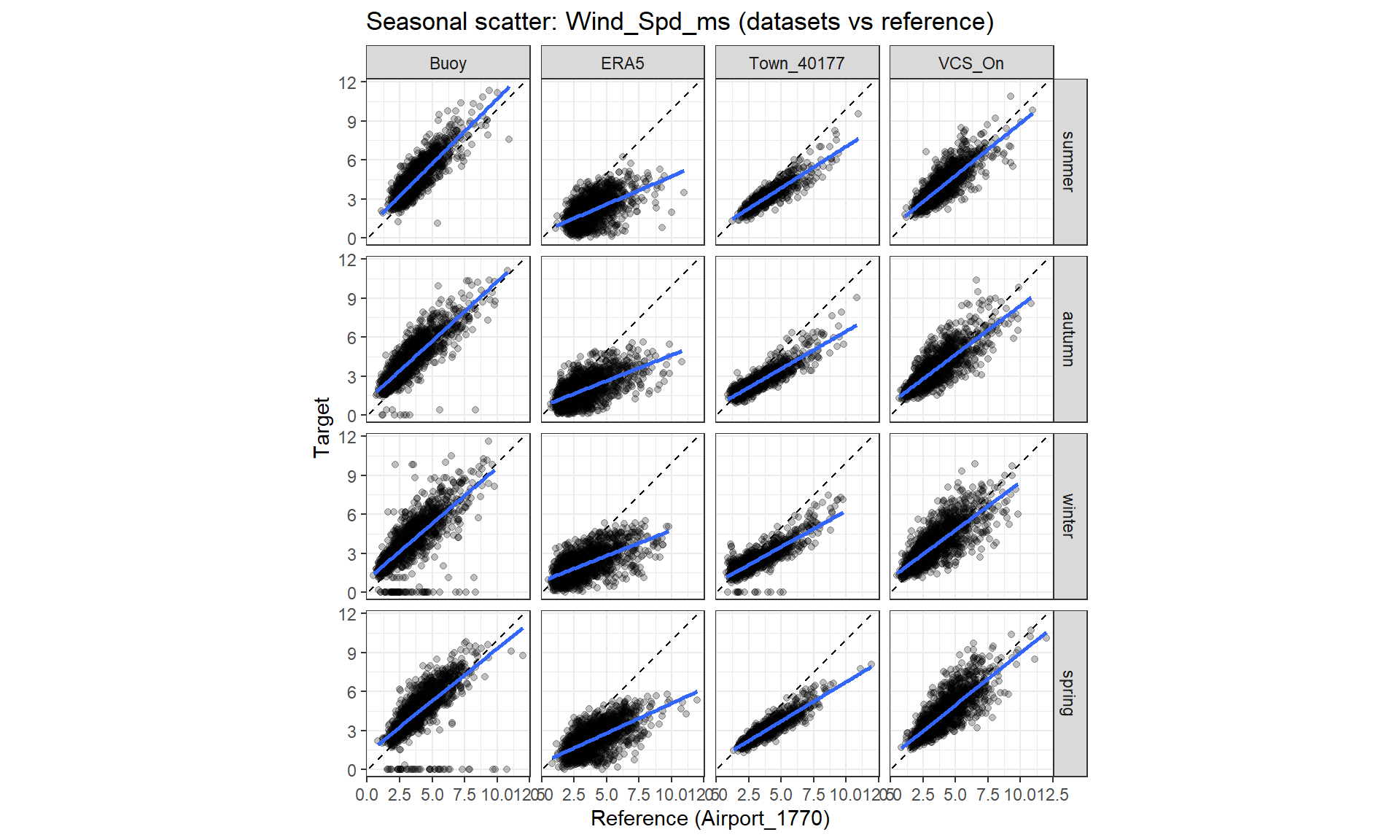
Town wind shows a consistent negative bias. The rolling bias below zero throughout the record, indicates that the Town_40177 data underestimates wind speed relative to Airport_1770. There is generally strong temporal agreement but the short sharp drops in correlation and sharp peaks in MAE and RMSE, indicate times of poorer agreement. The overall relationship is stable but occasionally disrupted (e.g., by local site effects or data issues). Town_40177 wind is suitable for capturing wind variability trends, but absolute values should be bias corrected if used for magnitude sensitive applications. ERA5 wind-speed performance is regime dependent. It reproduces the broad seasonal cycle and event timing, but underestimates magnitude most strongly during high wind peak events, while showing smaller bias under lower winds. The seasonal oscillation in bias indicates this damping effect varies through the year, consistent with stronger mismatch during storm periods. More caution is needed if using ERA5 wind data depending on what season you look at. The oscillation bias shows a greater underestimation in some seasons (stronger =cooler, weaker = warmer). ERA5 is useful for capturing wider scale temporal patterns in wind but should be bias corrected and evaluated seasonally before use in applications sensitive to wind magnitude. ERA5 tends to smooth out local extreme weather events. VCSN wind generally shows the lowest overall wind error, resulting in more confidence performance. More specifically when using wind data for magnitude sensitive work. ERA5 is the least suitable for local day magnitude, unless corrected for (Figure: wind scatter).
NoteRolling diagnostics plots (Wind)
(a) ERA5 vs Airport
(b) Buoy vs Airport
(c) Town vs Airport
(d) VSCN vs Airport
Figure 2: Rolling 30‑day diagnostics for daily wind comparing data target sources (Town_40177, ERA5, VSCN and Buoy data) to the reference (Airport_1770). Panels show 30‑day moving bias (source/target − reference), Pearson correlation (cor), mean absolute error (MAE), and Root mean square error (RMSE).
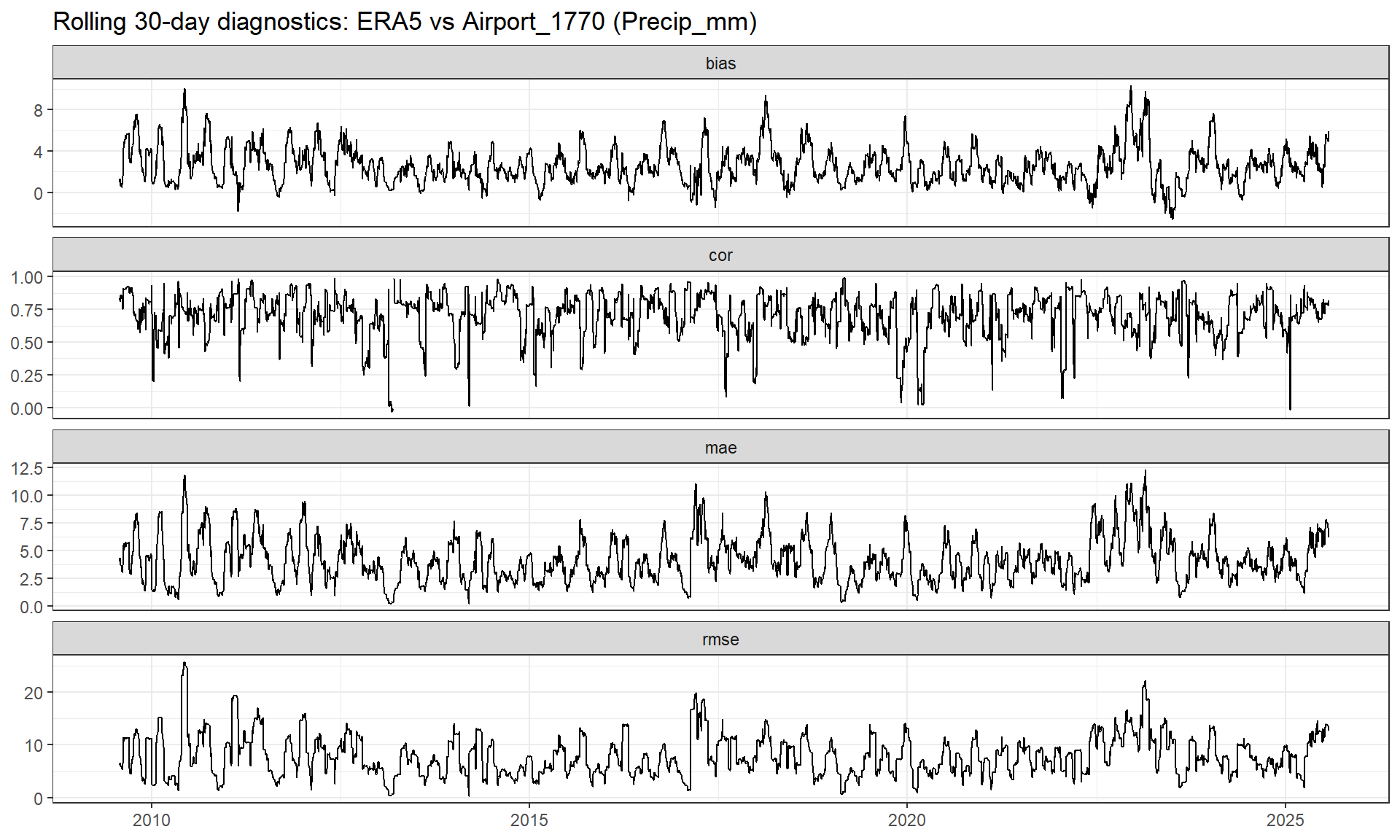
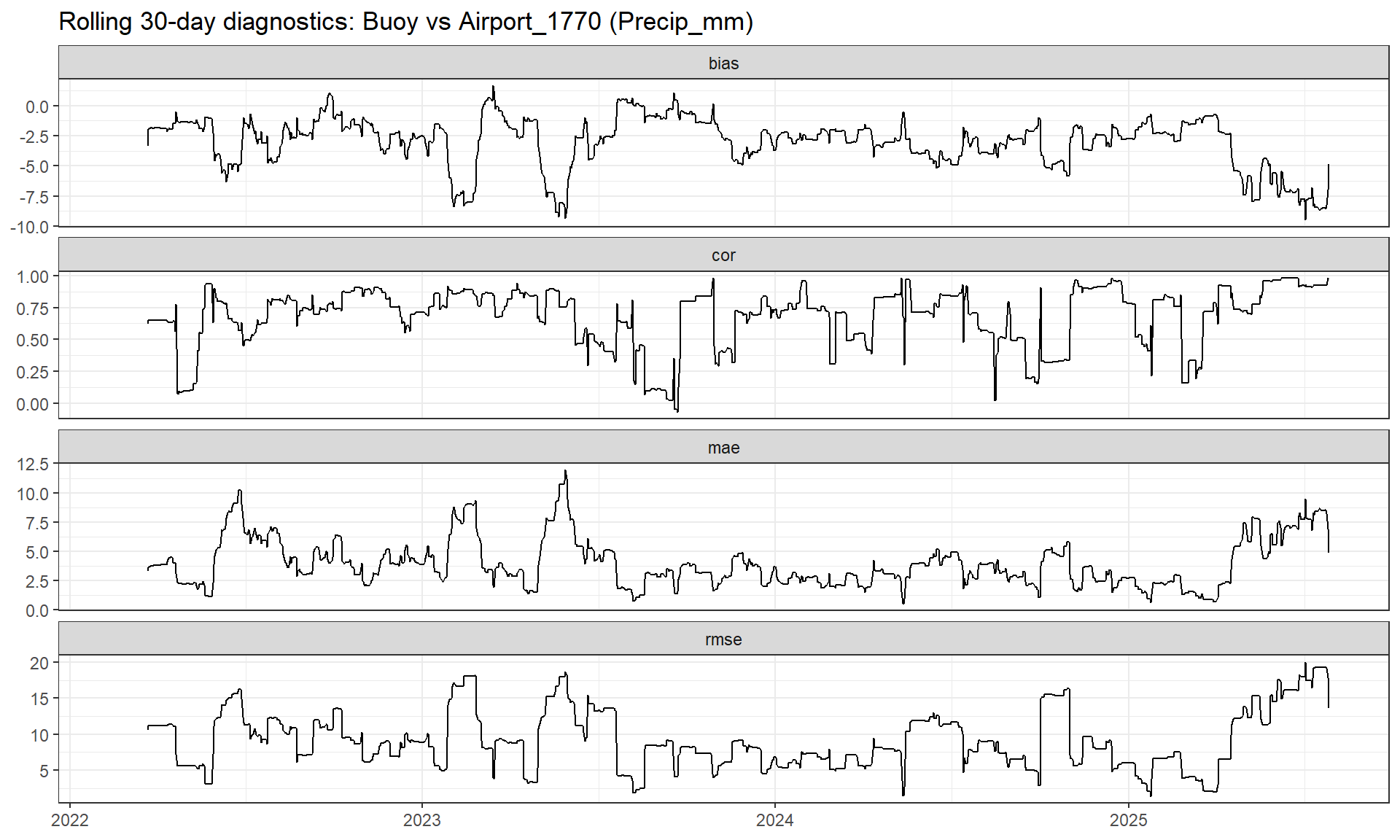
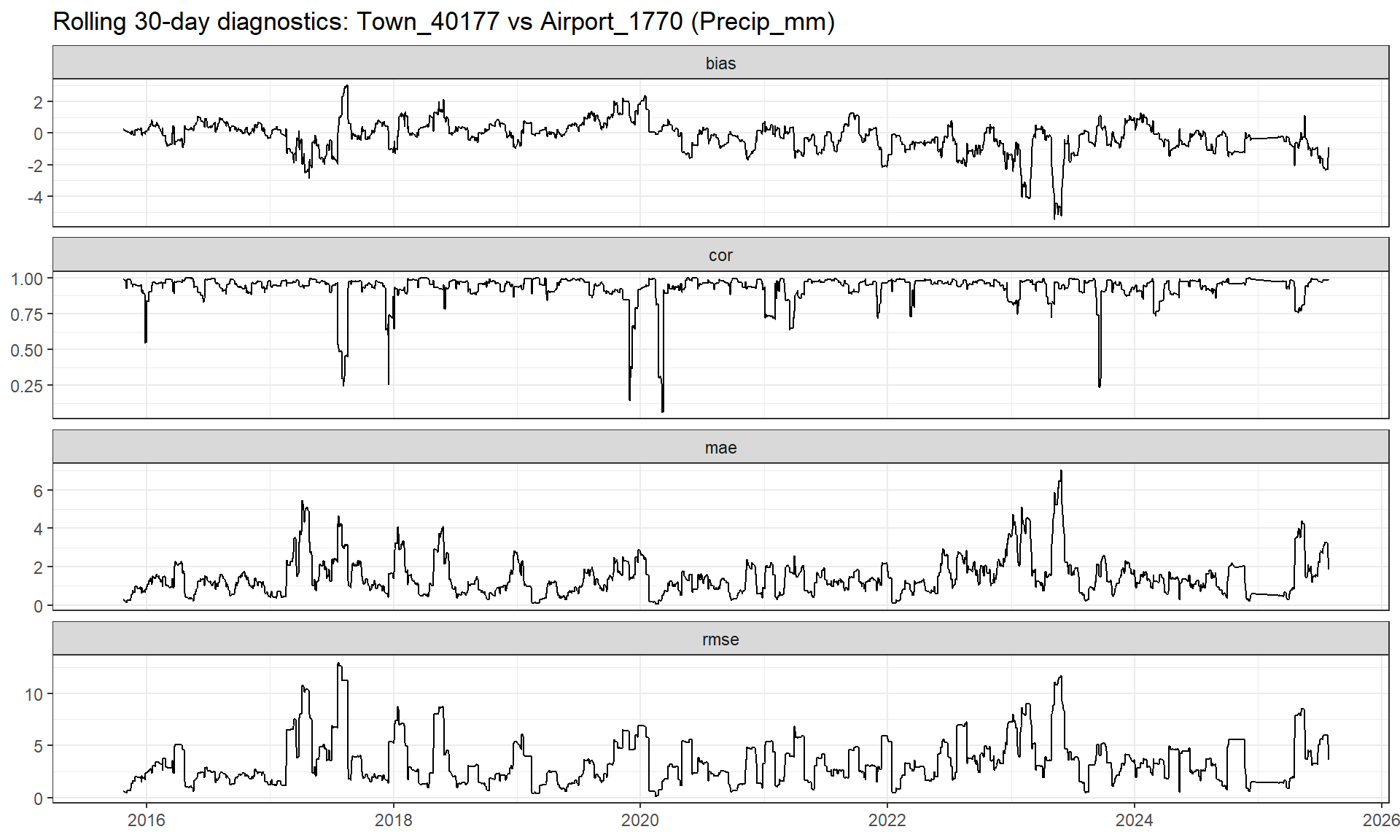
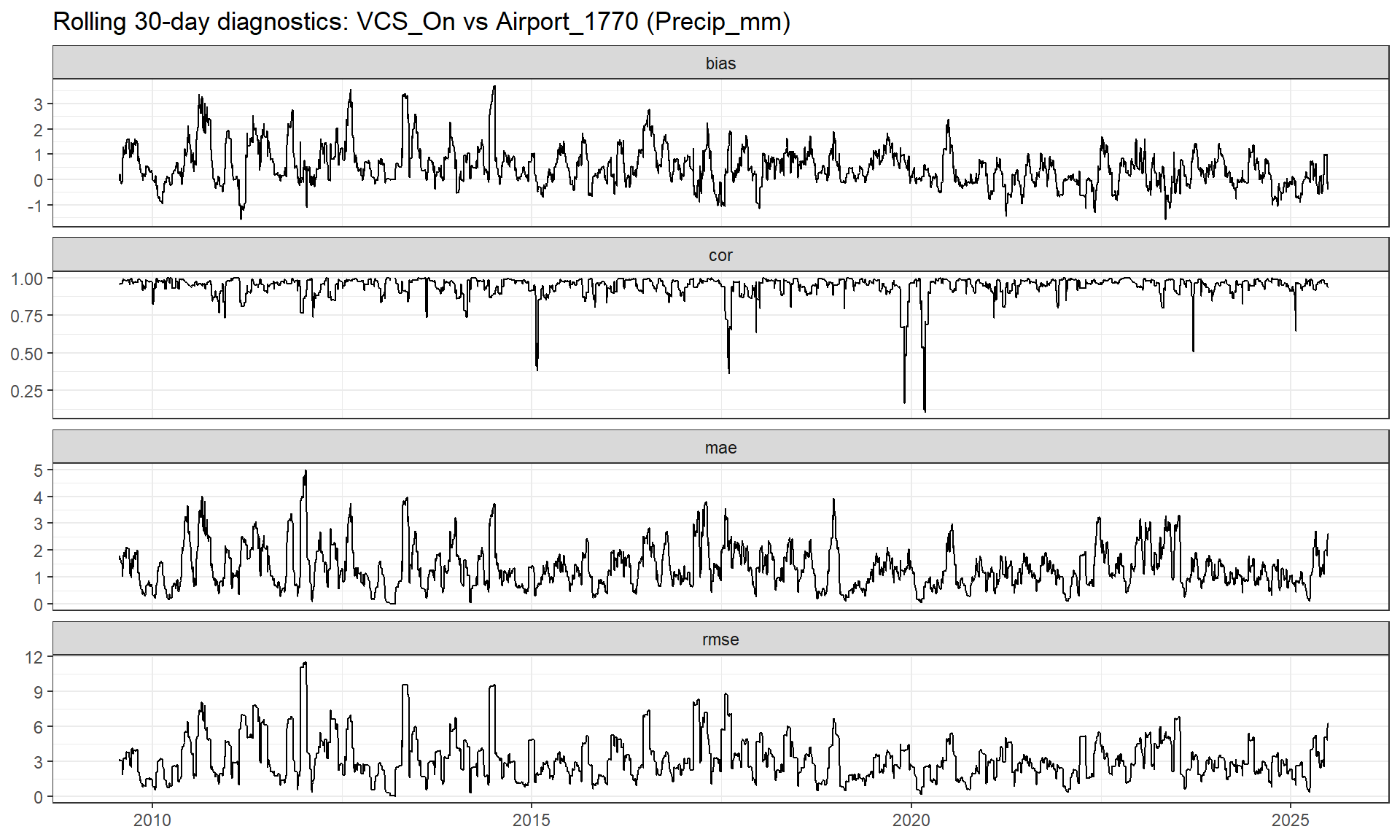
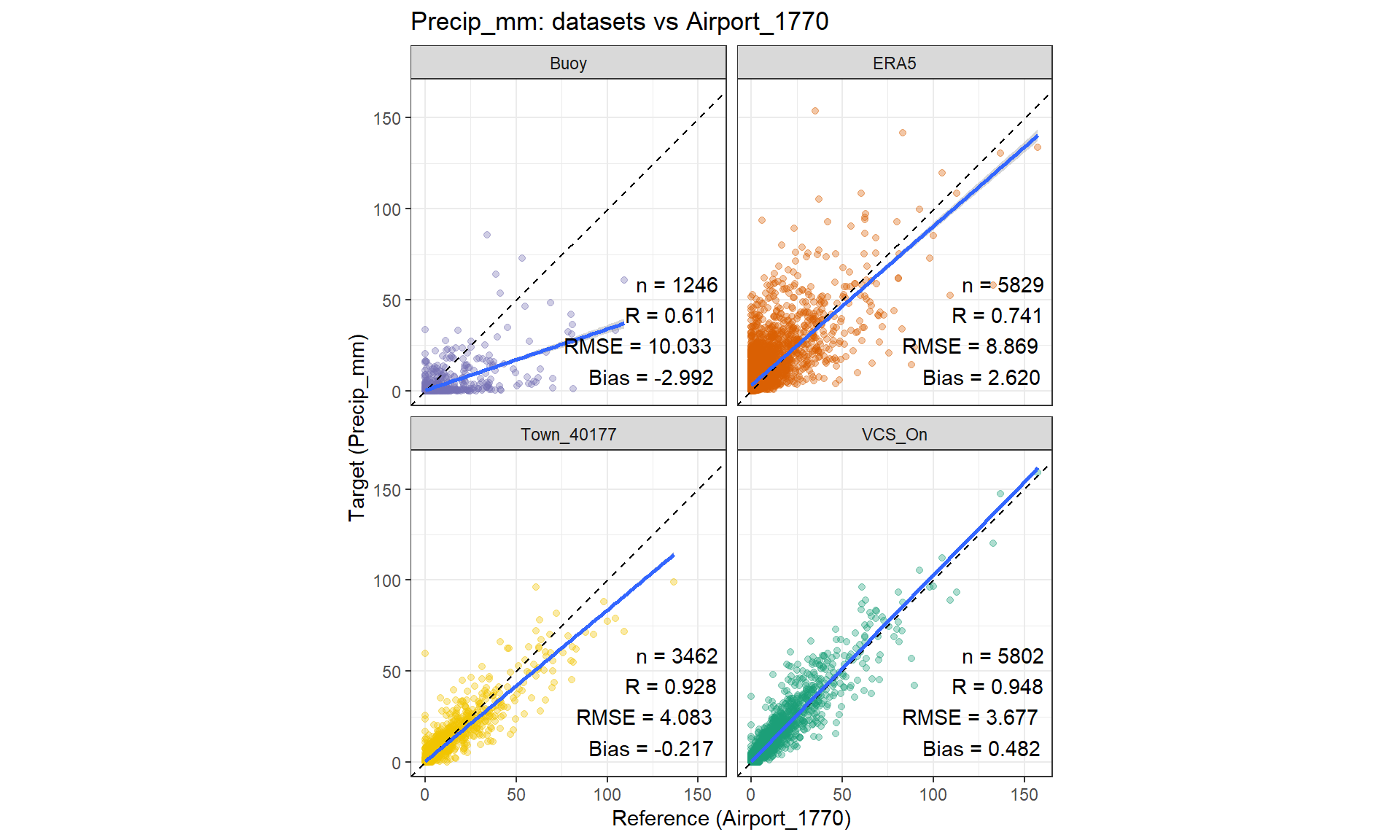
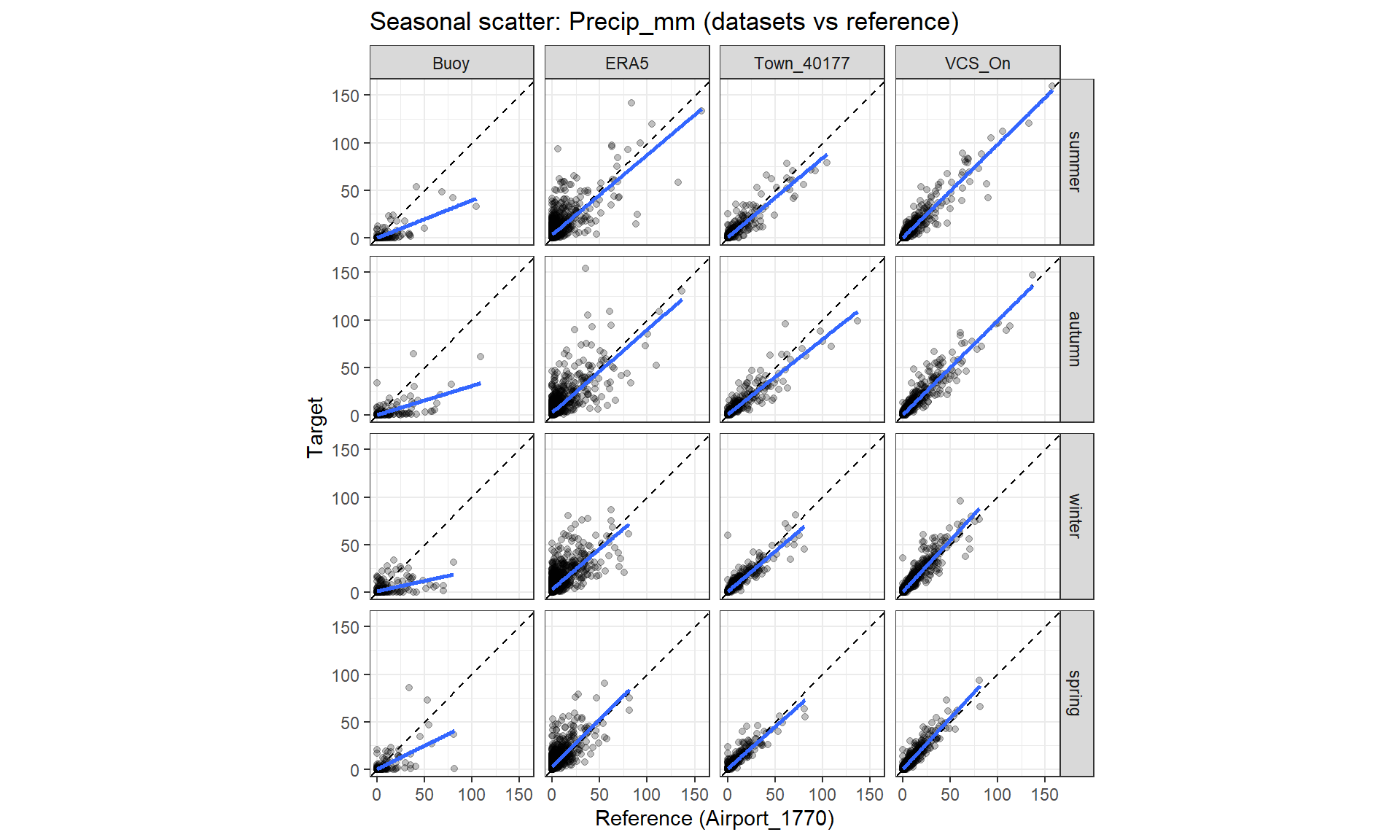
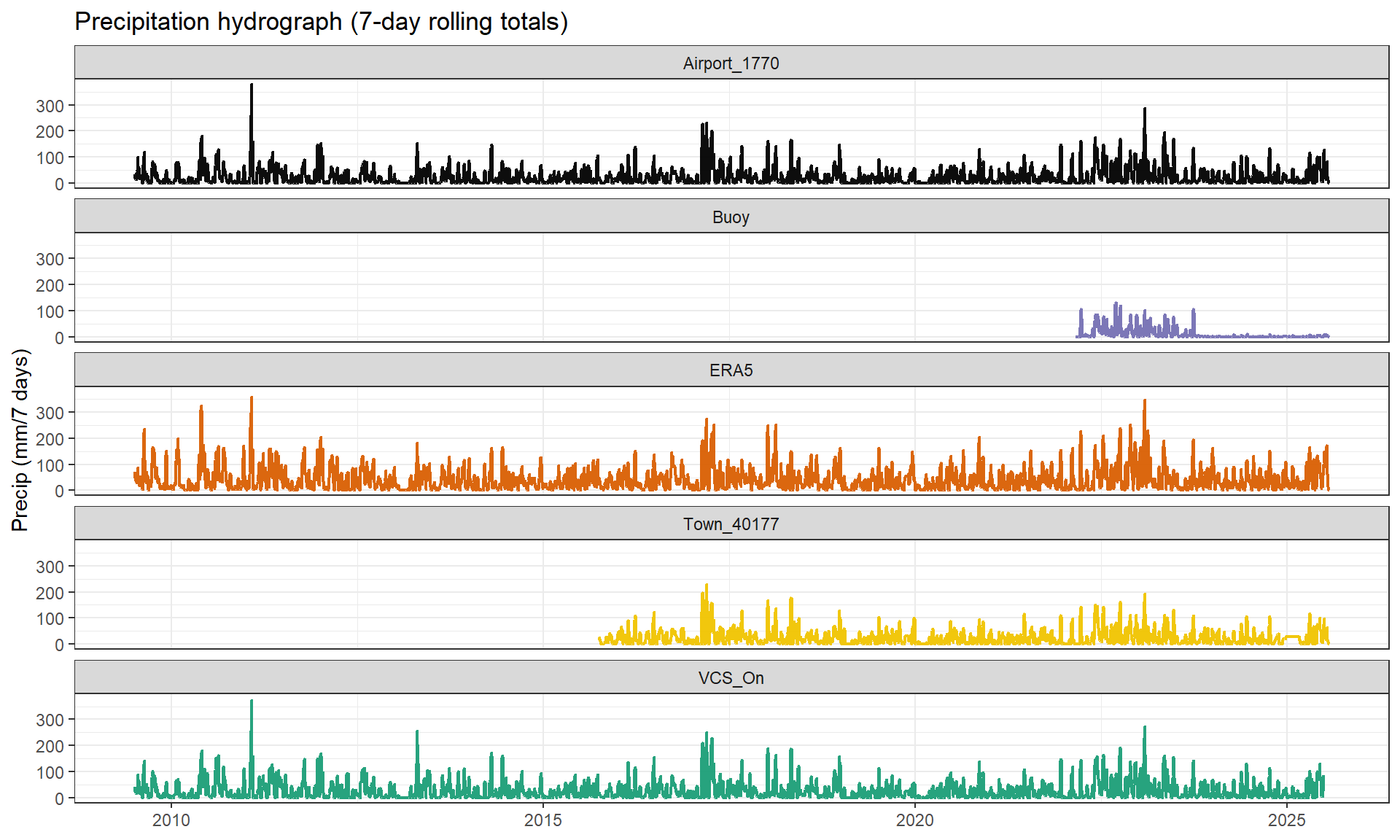
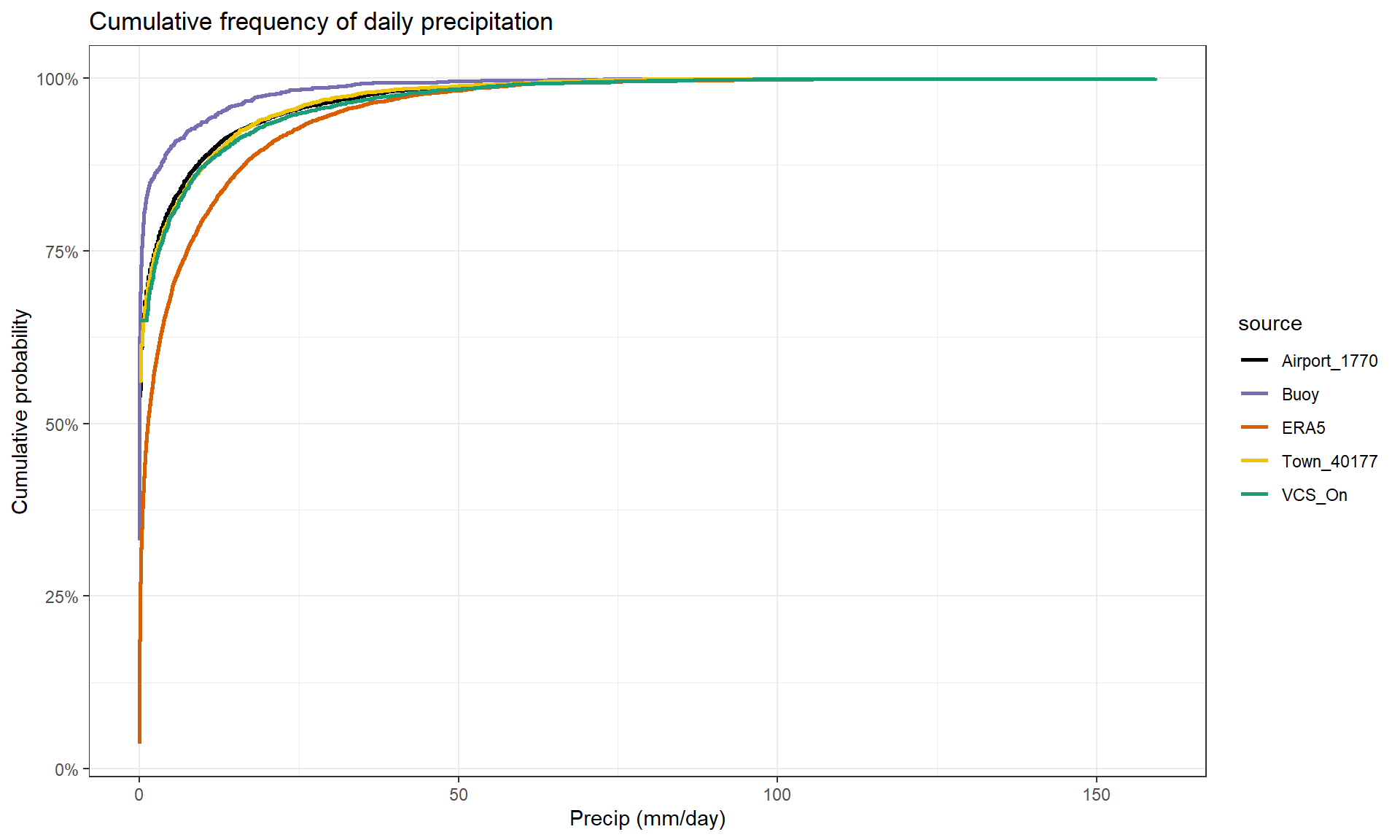
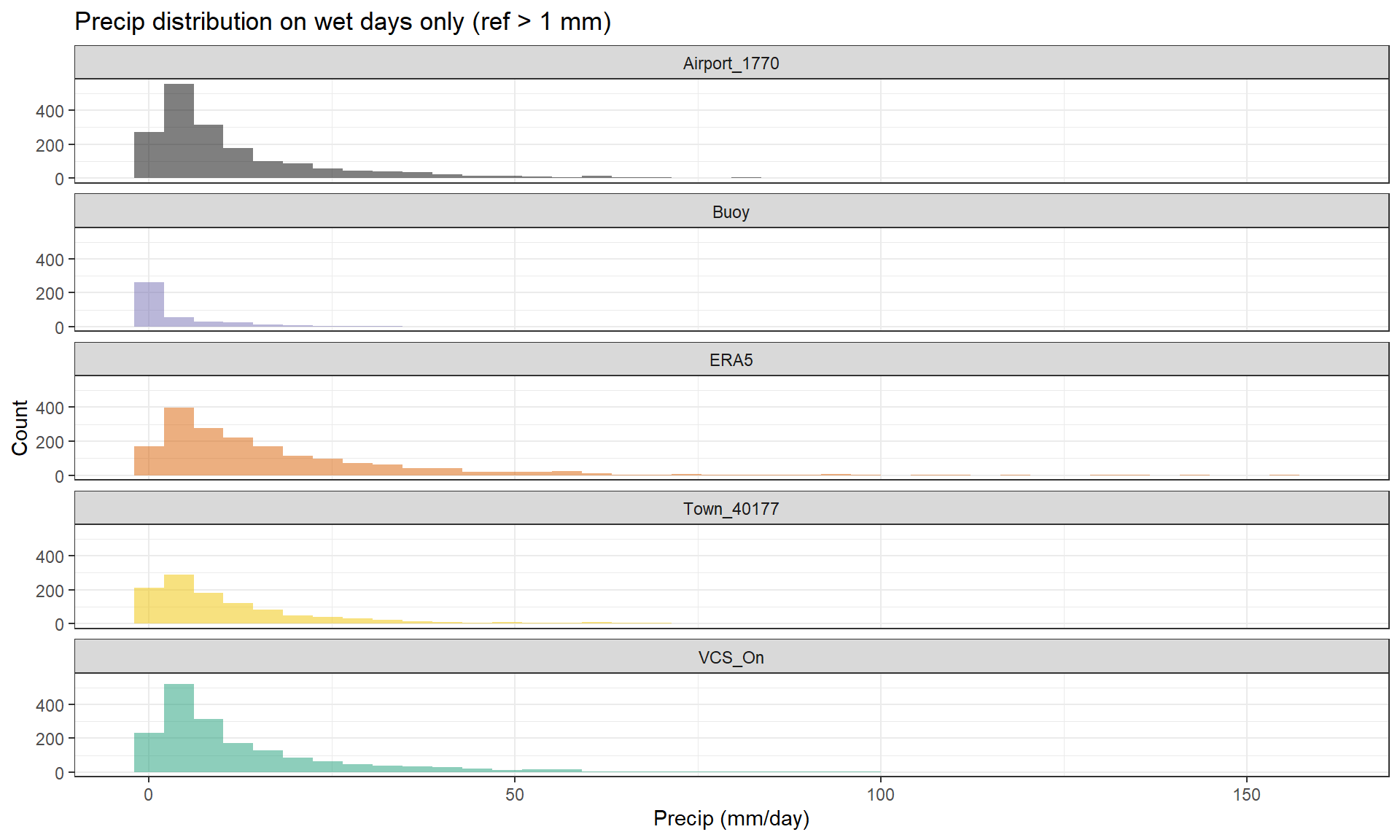
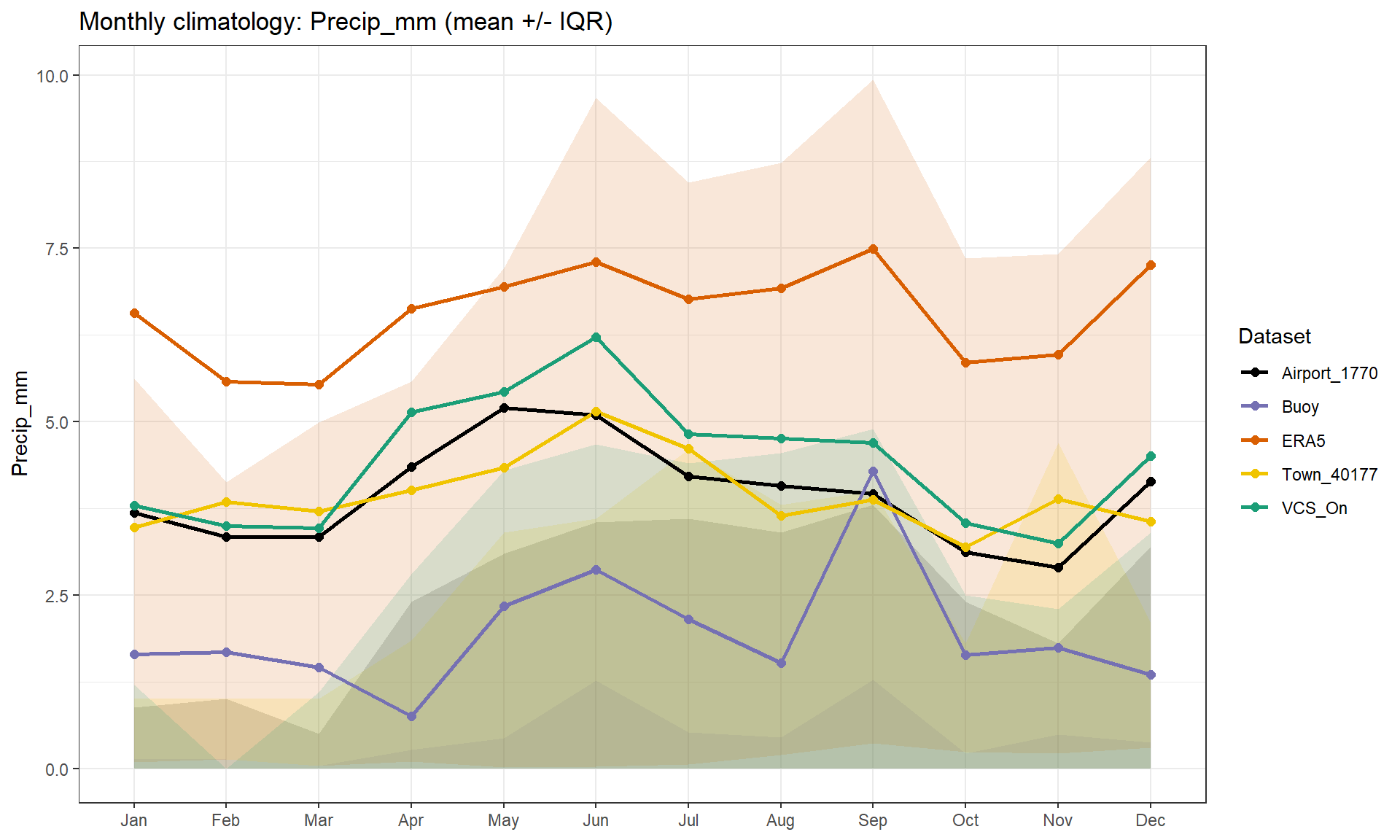
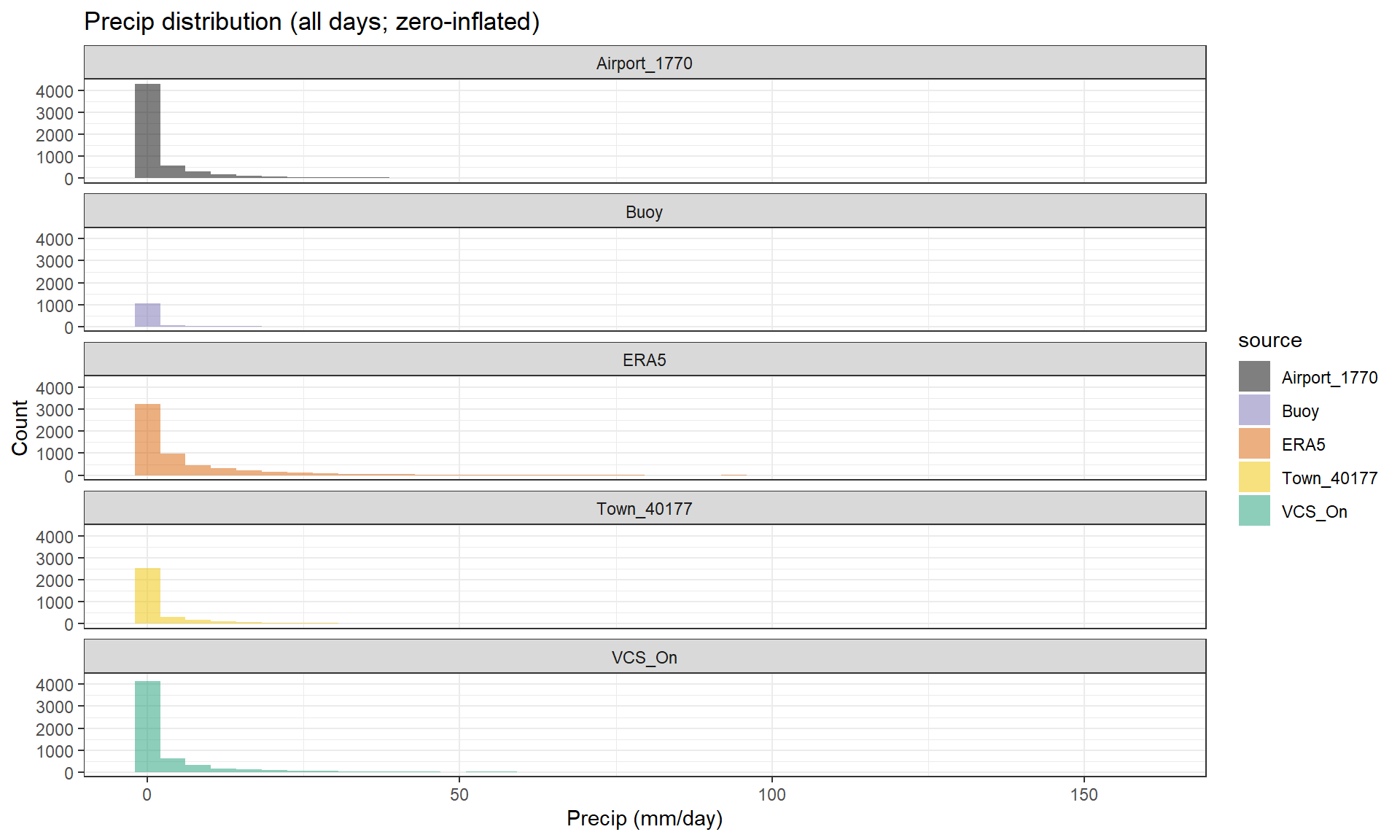
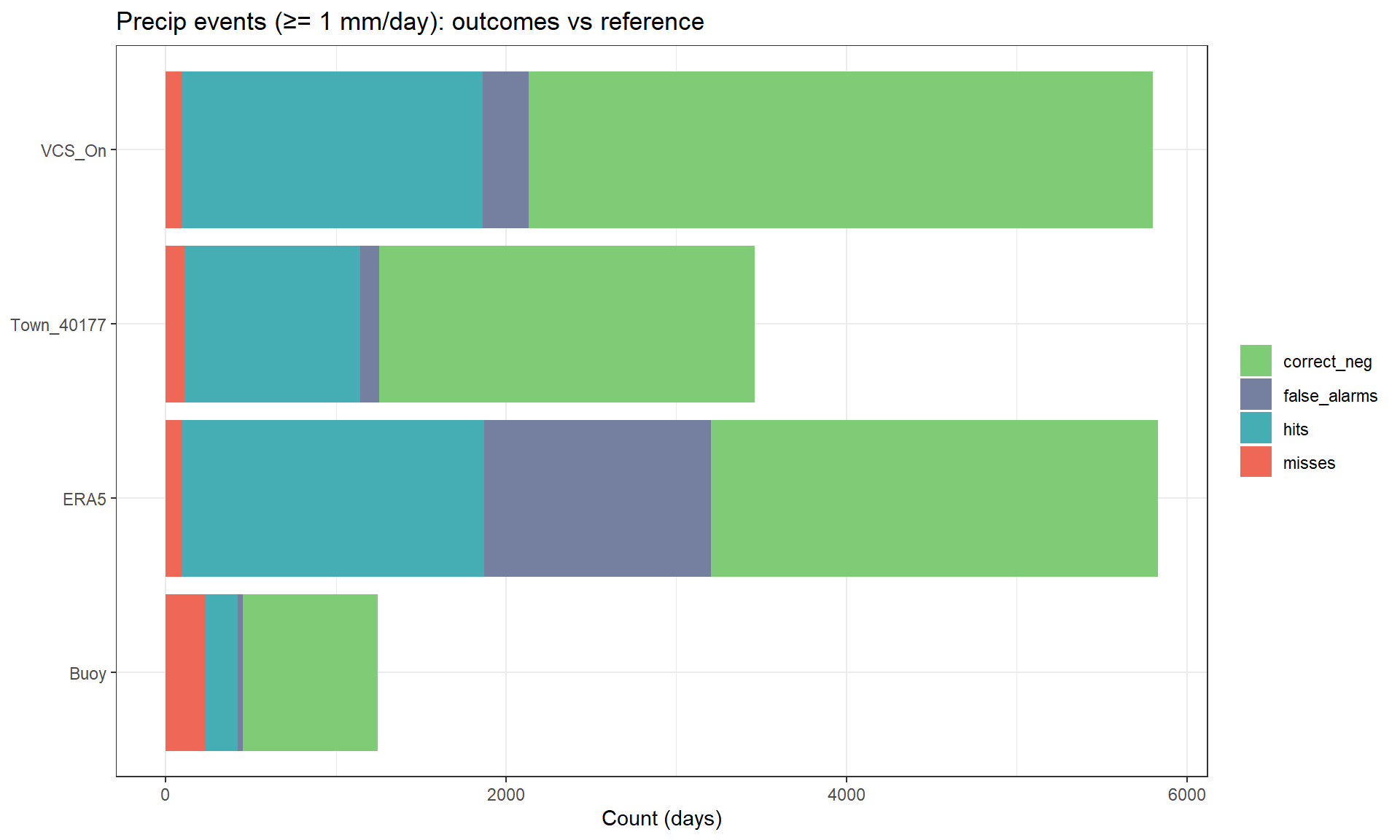
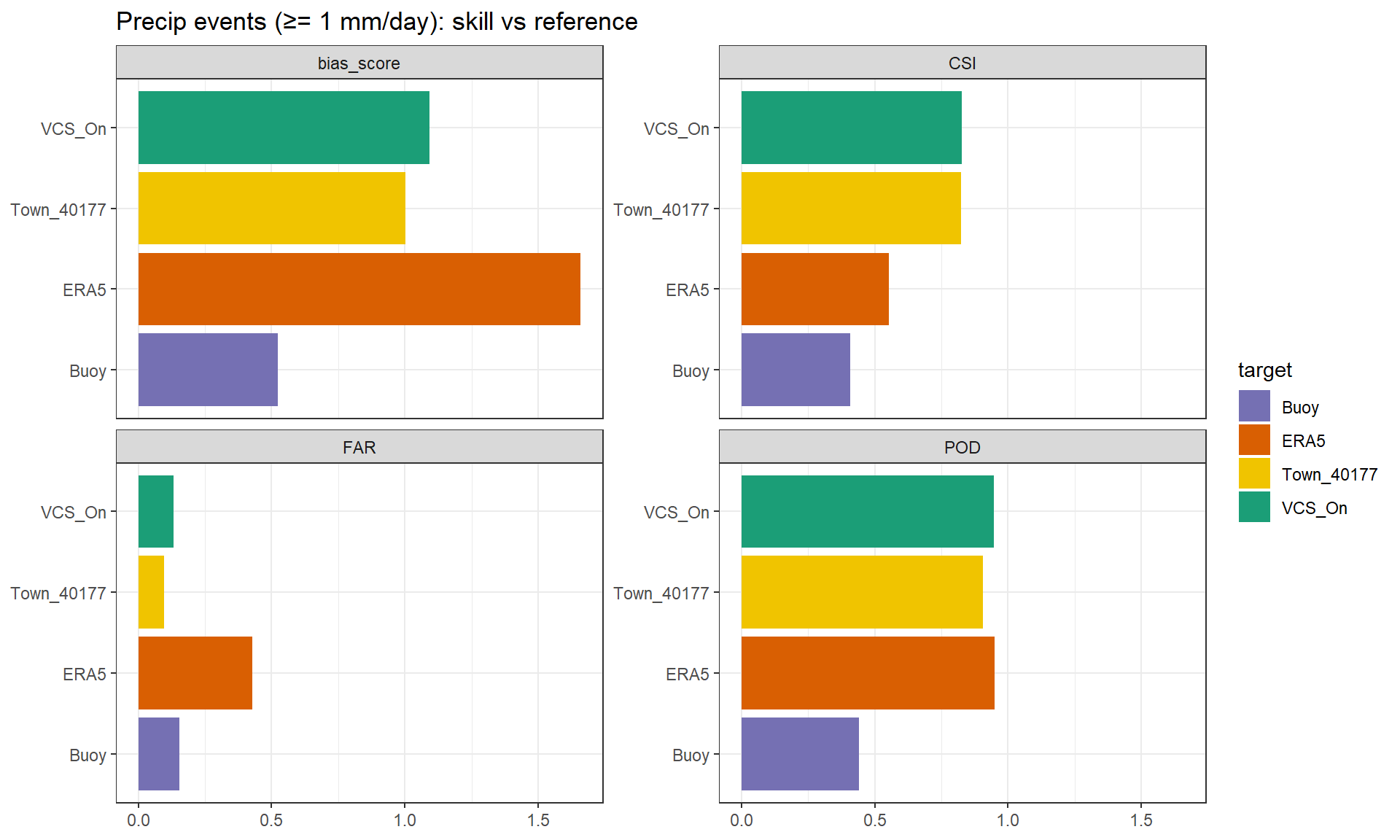
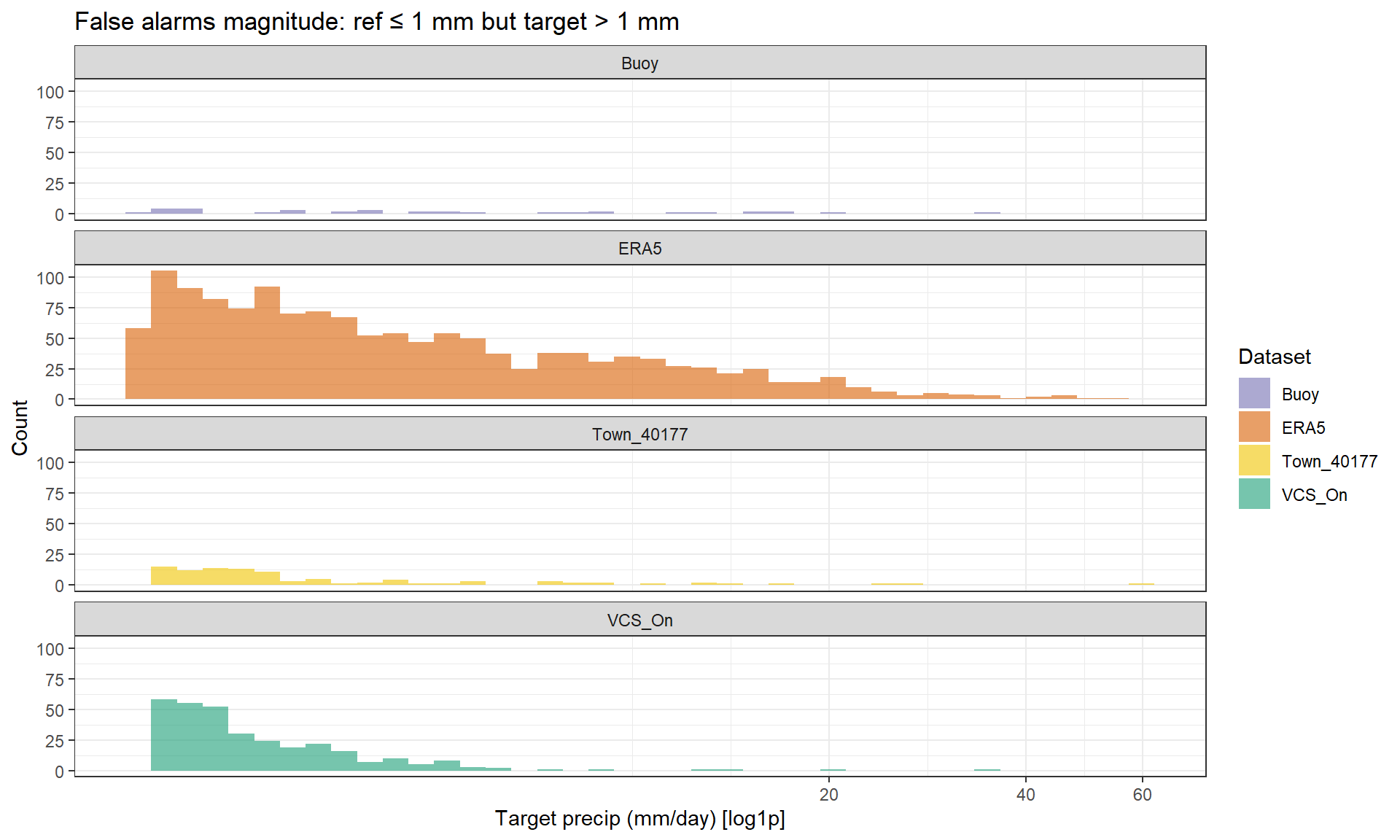
For precipitation, VCS and Town are the most reliable overall, while ERA5 tends towards higher wet-day values and more false alarms. Buoy precipitation is weakest for event detection (Figure: precipitation scatter), (Figure: event outcome), (Figure: Precipitation score), (Figure: False alarm), (Figure: Climatology rain). ERA5 has the potential to be useful for wider scale projects and when needing longer records which are consistent. But for a project which require high accuracy and precision for local rain events (e.g. threshold modelling, runoff timing, loading pulses), ERA5 should be a secondary choice unless bias corrected.
NoteRolling diagnostics plots (rain)
(a) ERA5 vs Airport
(b) Buoy vs Airport
(c) Town vs Airport
(d) VSCN vs Airport
Figure 3: Rolling 30‑day diagnostics for daily rain comparing data target sources (Town_40177, ERA5, VSCN and Buoy data) to the reference (Airport_1770). Panels show 30‑day moving bias (source/target − reference), Pearson correlation (cor), mean absolute error (MAE), and Root mean square error (RMSE).
All-days metrics are dominated by high amounts of zero rain values showing overall behaviouw but throwing off the over scores, wet-days/events will show where source differences truly are aligned or misaligned either in timing or magnatude. Preformance degrades in different seasonal periods or in strom events.
Althought the 30-day -rolling plots give us insight into overall preformance and patterns it can miss shorder events, dampening event timing and magnatude acuracy.
Project type recommendations – what do use when
When regarding seasonality or regime VCSN performs well in higher event situations (wet and windy). ERA5 temperature could be useful to use due to its clear, consistent temporal variability if needing to extend data or data gap fill, however adjustments will need to take place on an absolute level due to its cool bias. This is key to consider in lake level dynamic projects (e.g. water balance building). When it comes to Buoy and VCSN temperature recognising the spatial difference is necessary due to water/land differences. For this reason, both Buoy and VCSN temperature data are potentially better matches when it comes to lake process projects (e.g. ecological dynamics or evaporation calculations). For Climate change related projects, the ERA5 datasets completeness allows for more seamless and overarching comprehensive outcomes (Hersbach et al. 2020; Muñoz-Sabater et al. 2021; Setchell, n.d.). However, if possible, bias adjust against a local reference (e.g. Airport) data.
References
Frassl, Marieke A., Bertram Boehrer, Peter L. Holtermann, Weiping Hu, Knut Klingbeil, Zhaoliang Peng, Jinge Zhu, and Karsten Rinke. 2018. “Opportunities and Limits of Using Meteorological Reanalysis Data for Simulating Seasonal to Sub-Daily Water Temperature Dynamics in a Large Shallow Lake.”Water 10 (5). https://doi.org/10.3390/w10050594.
Hersbach, Hans, Bill Bell, Paul Berrisford, Shoji Hirahara, András Horányi, Joaquín Muñoz-Sabater, Julien Nicolas, et al. 2020. “The ERA5 Global Reanalysis.”Quarterly Journal of the Royal Meteorological Society 146 (730): 1999–2049. https://doi.org/10.1002/qj.3803.
Muñoz-Sabater, Joaquín, Emanuel Dutra, Anna Agustí-Panareda, Clément Albergel, Gabriele Arduini, Gianpaolo Balsamo, Souhail Boussetta, et al. 2021. “ERA5-Land: A State-of-the-Art Global Reanalysis Dataset for Land Applications.”Earth System Science Data 13 (9): 4349–83. https://doi.org/10.5194/essd-13-4349-2021.
R: A Language and Environment for Statistical Computing. 2024. Vienna, Austria: R Foundation for Statistical Computing. https://www.R-project.org/.